

Size reduction plays a vital role in powder processing, and the choice of equipment is one of the most important considerations for any application. It has a defining effect on key elements like particle size consistency, flow characteristics and overall material performance.
Within pharmaceutical, food and chemical processing environments, production engineers are often faced with a relatively straightforward choice when it comes to size reduction equipment comparison - cone mills, or hammer mills. Each one offers distinct advantages depending on the material, application and desired outcome.
If you’re currently weighing up the two options, the key differences between them will play an important role in determining the right solution for your own application. Here, our experts break down what sets conical mills and hammer mills apart, so you can make an informed decision as to which one is best for you.
What’s the difference between a conical mill and a hammer mill?
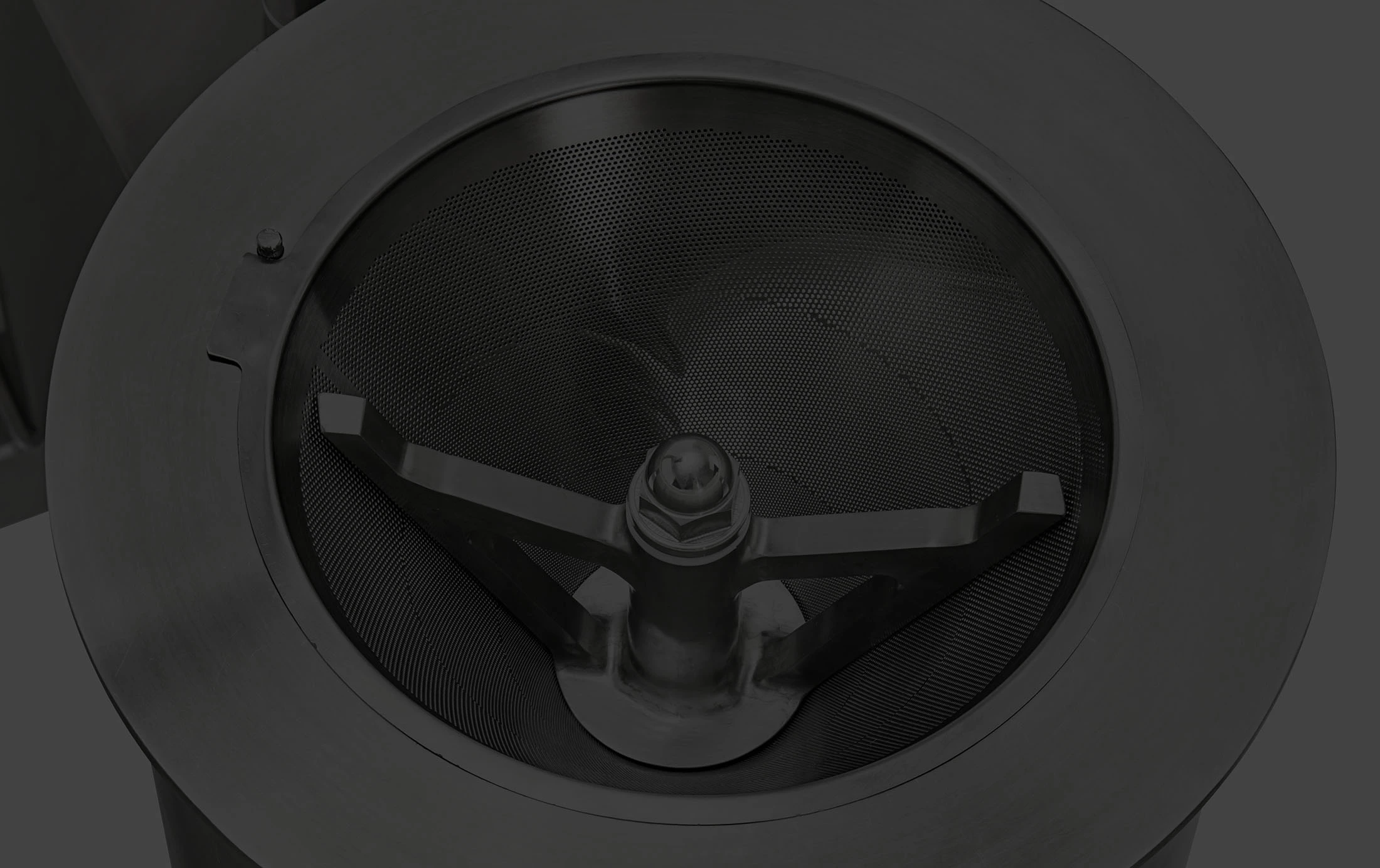
A conical mill and hammer mill are similar in their ability to reduce particle size and improve material handling, but crucially different in the way they process material, and the results they produce. Conical mills - like the Underdriven Comil® Conical Mill or Overdriven Comil® Series - are distinguished by a lower-speed milling process that uses a rotating impeller and screen to achieve controlled particle reduction with minimal dust and product degradation. This makes them particularly well-suited to pharmaceutical, food and other processing environments in which it is critical to maintain product integrity and achieve a uniform output.
Hammer mills, on the other hand, are designed for more aggressive particle reduction and are commonly used when processing tougher, bulkier or more fibrous materials. Using high-speed rotating hammers, they’re capable of achieving rapid size reduction and moderate throughput, making them well-suited to processing environments where the key priorities are focused on efficiency and volume.
What are the key mechanical differences between the two technologies?
The main difference between conical mills and hammer mills relates to the way each one processes and breaks down material. Conical mills use a gentler combination of shear and compression, allowing for more controlled particle reduction with lower heat generation and reduced product degradation. Hammer mills, by comparison, essentially strike the material repeatedly until it passes through a screen. These differences in operating speed, force and milling method can have a significant impact on particle consistency, throughput and overall process performance.
How do conical mills and hammer mills compare on performance and efficiency?
Conical mills and hammer mills each offer distinct performance advantages depending on the application, material and production requirements. To make the right choice for their own application, manufacturers need to take into account key factors like processing efficiency, particle size requirements and the sensitivity of the material being handled.
How do heat generation, dust levels, and noise compare between the two technologies?
These elements can all become important considerations when choosing size reduction equipment, particularly in processing environments with strict containment or cleanliness requirements. Since conical mills typically operate at lower speeds and use a gentler milling process, this helps to reduce temperature build-up and minimize product degradation throughout production. They also tend to create less airborne dust and lower operating noise than hammer mills. By comparison, the high-speed impact of hammer mills can create harsher operating conditions across the wider production environment. Depending on the application at hand, additional extraction or noise-control measures may also be required.
What throughput and capacity considerations are most important when choosing equipment?
Throughput requirements can significantly influence the type of milling technology that’s most appropriate for the intended application, particularly in large-scale production environments where processing speed has a direct impact on operational efficiency and output targets.
The most important considerations tend to include:
- Production volume requirements
- Processing speed and output targets
- Material size and toughness
- Particle size consistency
- Downstream handling and process stability
In many bulk processing applications, hammer mills are often preferred because they can handle larger feed materials and maintain moderate processing volumes over extended production runs. Their more aggressive milling action also makes them effective where rapid material breakdown is a bigger priority than tightly controlled particle uniformity.
Conical mills are generally chosen for applications that require greater control throughout the milling process. They help manufacturers to achieve more consistent particle sizing and reduce batch variation at high throughputs. This can be particularly important where downstream handling, blending or formulation accuracy may be affected by inconsistent particle distribution.
Explore Quadro's scalable milling platforms.
When is it best to choose a conical mill over a hammer mill?
A conical mill is typically the preferred choice when the main priorities are particle size consistency, gentle material handling and greater control throughout the milling process. Its combination of lower operating speeds and controlled screening allows material to be processed more uniformly, helping to achieve a tighter particle size distribution.
This lower-speed milling action also generates less heat and applies less mechanical stress to the material during processing. It is one of the main reasons why conical milling is so well-suited to applications involving heat-sensitive materials, products that are prone to degradation, or processes where downstream handling may be affected by particle size variation.
Common examples of these applications include:
- Heat-sensitive pharmaceutical powders
- Food ingredients and nutritional products
- Granules requiring sizing or deagglomeration
- Applications with strict particle size specifications
The increased level of control can help to improve batch consistency, reduce waste and deliver more stable production outcomes across the wider manufacturing process.
When will a hammer mill generally outperform a conical mill?
Hammer mills are effective for applications that involve substantial particle size reduction - especially those that involve hard, fibrous or coarse materials. Many of these materials are typically resistant to compression or attrition-based size reduction methods, and the high-speed impact action of a hammer mill enables it to efficiently process these challenging materials, while maintaining consistent output rates.
For example, fibrous ingredients can be broken down through repeated impact, while harder materials can withstand the more aggressive forces involved in hammer milling. With coarser feed materials, the impact forces generated within the mill can achieve significant particle size reduction both quickly and efficiently.
It is also worth noting that hammer mills are equally well-suited to applications that require significant particle size reduction in a single pass, helping manufacturers to efficiently handle large production volumes. Essentially, in any application where achieving a fine particle size matters more than preserving particle integrity or minimizing heat generation, a hammer mill can deliver the performance required while maintaining the required output across demanding production schedules.
Why does scalability matter when choosing size reduction equipment?
Scalability is a critical consideration in powder processing, ensuring that processes being developed at laboratory or pilot scale can be successfully transferred to commercial production. Accordingly, manufacturers need to ensure that their choice of size reduction equipment can consistently maintain the required particle size distribution, throughput, and process stability from early-stage development batches through to full-scale production. The ultimate goal is to ensure that the equipment is capable of maintaining predictable output throughout any future increases in production volume.
Beyond strictly supporting production growth within the existing process conditions, a scalable approach also involves choosing equipment that can adapt to any changes in process requirements over time. Equipment platforms that support multiple processing technologies can provide manufacturers with greater flexibility as production demands evolve.
On this note, exchangeable head platforms enable manufacturers to use multiple processing technologies within a single system, increasing the platform's adaptability as production requirements evolve. This can be particularly valuable when processing a diverse range of materials or when future production requirements remain uncertain. In these situations, a multi-technology platform can provide manufacturers with the flexibility to accommodate different size reduction methods without the need for significant equipment changes, helping them to maintain efficiency across a broader range of applications.
How can Quadro help?
We are the inventor of the original Comil® conical mill in 1976, and through our partnership with Fitzpatrick within IDEX Material Processing Technologies, we are uniquely positioned to support manufacturers with both conical and hammer milling expertise under one roof. With over a century of combined experience in particle processing, between us we help customers evaluate material characteristics, processing requirements, and scalability considerations to identify the most appropriate size reduction technology for their application.
This capability is further strengthened by Quadro’s industry-leading range of screens and impellers, together with proprietary exchangeable head platforms such as the SLS and SDx Series, which provide manufacturers with greater flexibility as their processing requirements evolve.
Whether you're assessing a new formulation, optimizing an existing process, or planning for commercial scale-up, our specialists can help you choose and optimize the right milling solution for your production objectives. Speak with a specialist via the
Contact Us page to discuss your application and processing requirements.

Topics:
Particle size distribution