

Replacing screens and impellers with third-party replacements is an attractive option for many operators. After all, the savings are immediate and can be easily compared with an original equipment manufacturer (OEM) quotation.
The harder costs to see, however, are the ones that appear once the screens and impellers have been installed. While a replacement can be installed into the machine without a problem, it can behave differently enough during operation that it affects particle size distribution (PSD) and the levels of throughput that the mill usually produces.
These effects matter, especially when you consider the important relationship between screens and impellers and how they determine the way the material moves through the milling chamber and exits through the screen.
Here, we’ll show what buyers should compare, beyond unit price, and how different tolerances can impact the process. This guide will help procurement managers and quality teams know what to verify before choosing a replacement part.
What is the difference between genuine OEM and third-party aftermarket mill parts?
Genuine OEM mill screens or impellers are supplied to the specifications established for the original equipment, while a third-party replacement is manufactured by another supplier to work with that machine. In the case of third-party parts, the manufacturer, controls, and specifications behind the replacement are different.
The definition of compatible needs to go beyond the fact that the part can be easily installed. For process-critical tools, the central question should be whether or not the replacement reproduces the dimensions and operating characteristics that matter to that mill’s performance.
All this is not to say third-party manufacturers are poor by default. The buyer’s challenge is that apparently similar parts can differ in details that are harder to evaluate from basic information such as quotations and product photographs.
Why does the fit between the screen and impeller matter so much?
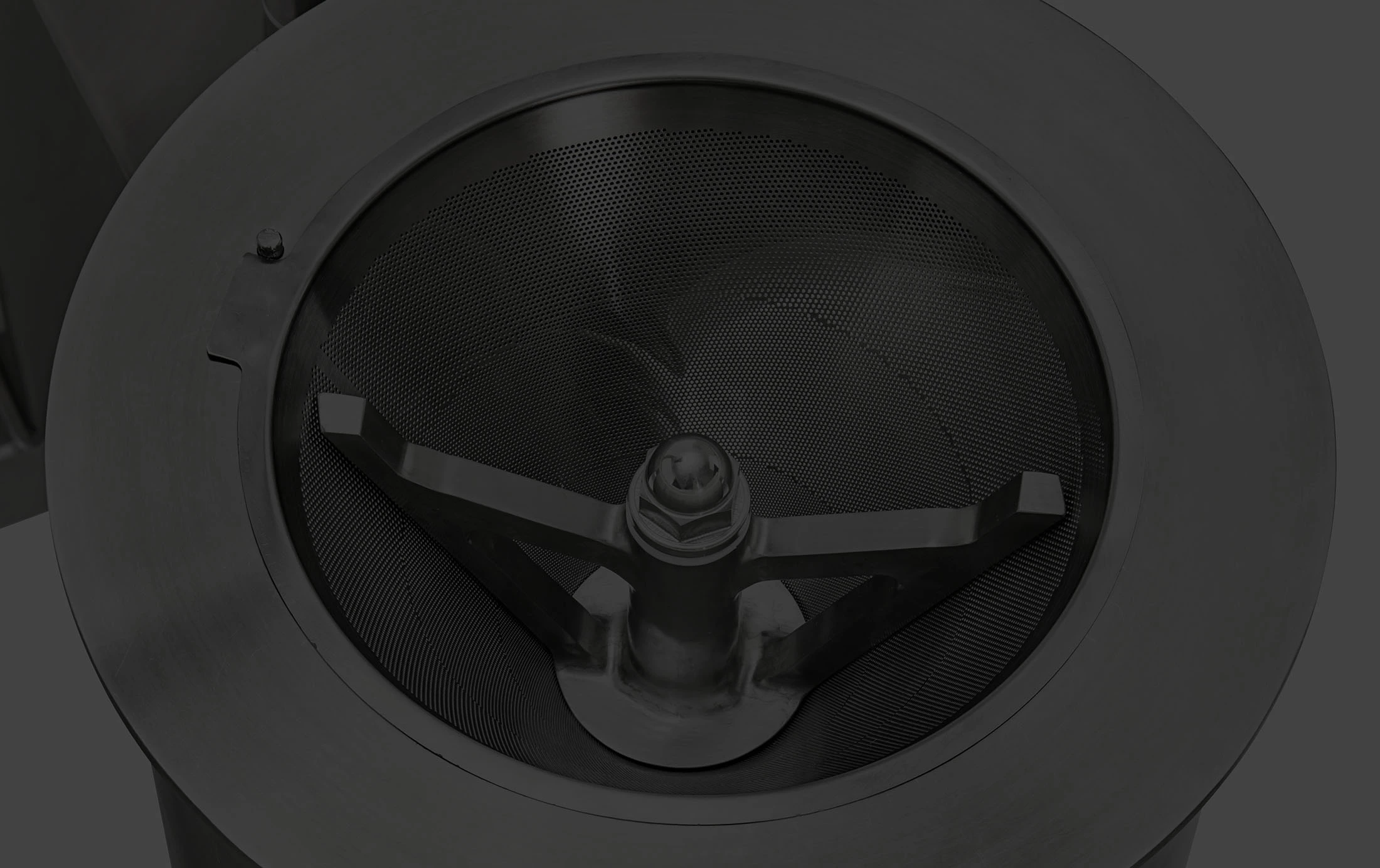
Inside cone mills, rotating impellers move the product toward the screen, which is made up of small holes. Material leaves the milling chamber once it has been sufficiently reduced in size to pass through the apertures. The geometry of the impeller and screen, then, helps determine the type of milling action.
The clearance between the impeller and the screen is part of this relationship, and if a replacement does not reproduce the intended dimensions consistently, the material will likely experience a different milling environment from one that was originally established.
The characteristics of the screen matter too. Hole size and type influence the way material is reduced and discharged out of the mill. At Quadro, we have seen and attributed poorer performance from replacement third-party aftermarket and OEM mill screens to reduced open areas and incorrectly configured impeller gaps.
This is why a claim that a screen or impeller has the same hole size or that it will fit the model isn’t always enough information to establish true equivalence. The whole screen-and-impeller relationship matters for process-critical equipment.
Where can the apparent savings on a cheaper part disappear?
Particle size drift can turn a component saving into product loss
Screens and impellers are the two most significant components in a cone mill and influence how the material is broken down. In fact, research by the National Library of Medicine (NIH) shows that configuration can affect median particle size, the distribution of said particles, and the proportion of fines produced.
If a replacement - be it genuine or third-party aftermarket sourced- changes that established milling action, the cost is no longer limited to the screen or impeller. Product, which would have once moved through the process without issue, now requires further processing because the new parts aren’t able to replicate the same result. Or worse still, the batch has to be scrapped.
Reduced throughput can make the mill more expensive to operate
Replacement parts which restrict the amount of material that can move through the milling chamber extend the processing time even if what the mill is producing is acceptable.
So while the product leaving the chamber is essentially the same, there is less of it being produced in the same processing window, which is a cost that can be easily overlooked during purchase because it appears during production.
Poor fit can create wider maintenance and quality concerns
While their relationship is vital, screens and impellers never actually come into contact. Their installation and fit, then, need to be perfect so that the reduction in the size of the product before it leaves through the screen is optimum.
Replacement third-party aftermarket or OEM mill screens that change the required relationship raise serious questions about whether they will introduce abnormal wear or contact elsewhere in the milling zone.
Those in charge of purchasing cone mill spare parts should scrutinize whether suppliers are able to demonstrate what the replacement is made from and whether successive parts have been manufactured in the right way. This is especially important for applications with strict quality requirements.

How should you compare OEM and third-party parts on true value?
Comparing true value does start with the unit price, but it shouldn’t end there. The more useful, in-depth assessment should compare the cost of achieving the required production result over the useful life of the component.
A part that has a more expensive upfront cost may in fact provide better long-term value if it is able to retain expected throughput and reduce the likelihood of any disruption.
Cheaper alternatives only represent an actual saving if they can deliver the required performance without creating additional financial or operating headaches.
Procurement should assess the replacement alongside engineering and quality requirements rather than treating it as a simple, like-for-like purchase.
A supporting comparison table to help you look beyond the quoted part price
| What to compare | Question to ask |
| Initial purchase price | What is the actual difference in unit cost? |
| Equipment specification | Does the replacement match the specification required for this exact mill and tooling configuration? |
| Manufacturing tolerances | Can the supplier demonstrate dimensional tolerances relevant to fit and repeatability? |
| Screen specification | Are aperture size, open area, and required material specification equivalent? |
| Process performance | Can the part maintain the required throughput and particle-size result? |
| Service life | How often is the component likely to require replacement under typical operating conditions? |
| Production impact | What would slower processing, rework, or an unexpected changeover cost if performance changes? |
| Documentation | Can the supplier provide the information the quality system requires to approve and trace the replacement? |
What should you verify before approving a replacement screen or impeller?
Before approving a replacement screen or impeller, start with the exact equipment and original part specification. Picking parts from generic spec sheets that claim components are compatible with a certain range of cone mills,, is not a high enough watermark.
Ask the supplier how dimensional conformity is controlled and what specification applies to the features which could negatively impact the screen-impeller relationship.
Ensuring consistency between successive replacement parts matters as much as the installation appearing to work.
Then, confirm the screen specification rather than focusing on just the aperture diameter. The spec includes more than just hole size, taking into account open area, material grades, and manufacturing tolerances.
Quality teams should agree on what documentation is required from the supplier for their particular process before they make a final purchase decision.
Why genuine Quadro parts are designed to preserve Comil performance
Selecting genuine Quadro screens and impellers removes one key uncertainty for procurement teams. They can be assured that they are being supplied by the manufacturer responsible for the genuine Comil parts and its tooling specification.
This factor matters because replacing tooling isn't simply a case of reproducing its general shape. The aim is to maintain the relationship between the part and the wider milling process so that it can continue to perform as intended, with as few interruptions as possible.
Our teams at Quadro can identify parts according to the equipment, material, and production requirements and, if necessary, advise when an alternative screen or impeller configuration is needed because the process itself has changed.
Genuine screens and impellers are supplied through Quadro Aftermarket services, where the team will offer ongoing support.
The cheapest replacement is the one that delivers the lowest process cost
Comparing OEM and third-party parts is not as simple as comparing quotes and opting for the more affordable option. The key question is whether the replacement continues to give the process the performance it requires.
For those responsible for non-critical applications, the trade-offs between genuine vs third-party aftermarket parts may be treated differently compared to teams in charge of tightly controlled production processes. Regardless, the key thing is to ensure that a decision is made deliberately, rather than assuming two physically compatible parts are the same.