

Consistent particle size distribution is one of the most universal priorities for pharmaceutical manufacturers producing oral solid dosage products. It’s a challenge that requires particularly close attention during wet granulation. The process spans several key stages - pre-conditioning, wet milling and dry calibration - and PSD can shift at every one of them. This is largely because each stage introduces new process conditions, which can variously alter the granule density, moisture distribution, and uniformity of particles.
However, pharmaceutical manufacturers who can successfully maintain tight PSD control across every stage can achieve both a stronger batch consistency and more reliable process performance, especially at a commercial scale. Quadro provides specialized solutions designed to help maximize this tight PSD control over the entire process.
- Pre-conditioning equipment prepares raw materials for more uniform granulation
- Wet milling systems can then help process teams to manage agglomerate size and granule consistency
- Following drying, final calibration milling can help manufacturers to achieve tighter PSD specifications before compression, providing greater control over granule flow, bulk density and tablet consistency
Let’s take a look at how it all works in more detail.
Why PSD is critical across the entire wet granulation process
Wet granulation produces granules by wetting and agglomerating powder ingredients. The resulting Particle Size Distribution directly affects tablet weight consistency, disintegration time, dissolution profile, and bioavailability. It also influences a number of additional factors, including how material flows through downstream equipment, and how reliably the finished products meet quality specifications.
Crucially, the PSD at final tablet compression reflects every processing and milling stage that came before it, so it therefore needs to be kept under careful and continuous control. A PSD deviation at any stage can create wider manufacturing problems throughout the remainder of the production process. This can include tablet capping, content uniformity failures, and dissolution results that fall outside of specification. Similarly, small PSD shifts between batches can also create validation challenges during scale-up and commercial manufacturing.
To avoid this, process engineers need a thorough understanding of how it can change throughout wet granulation, and which controls have the most influence on granule consistency at each stage. We’ll go through each one step by step below.
Stage 1 — PSD Control at Pre-Conditioning (Screening, Delumping & Milling)
Before granulation begins, incoming API and excipient powders are often agglomerated or lumpy. This inconsistency in input PSD can carry through the entire wet granulation process. Uneven particle populations and agglomerates can affect liquid distribution during granulation, alter drying behavior, and contribute to downstream compression and dissolution issues.
The pre-conditioning stage is designed to address this directly. It prepares powders by breaking down the agglomerates and establishing a more consistent starting PSD before any liquid addition begins. Process engineers may also use the pre-conditioning stage to reduce oversized particles, and align the feed material more closely with their specific target PSD.
We’ve designed the Quadro FlexSift with this in mind. Built for soft agglomerates and light delumping applications, the FlexSift provides gentle conditioning alongside security screening before granulation. This type of conditioning is instrumental for removing foreign material and removing soft lumps, and crucially without introducing aggressive particle size reduction that could affect sensitive formulations.
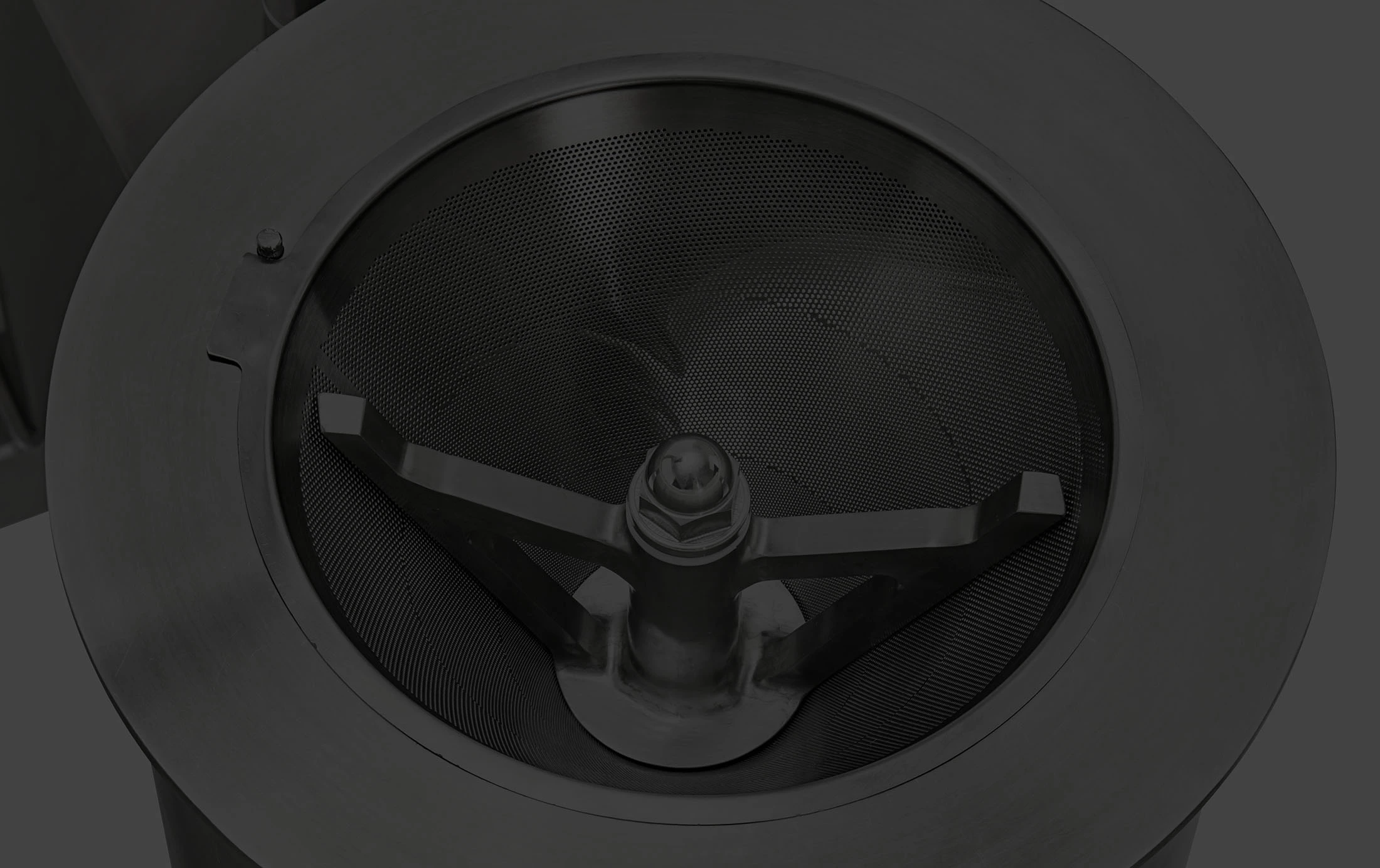
In instances where formulations contain harder agglomerates, or those that require particularly tight control over incoming PSD, the Quadro Comil can provide controlled deagglomeration before granulation begins. With a large screen and low impeller speed, it’s able to achieve tight control without excessive fines generation, helping to create more predictable downstream processing conditions.
Pre-conditioning improves blend homogeneity and fluid bed drying uniformity downstream. In other words, the PSD established at this stage will influence every stage that follows. It’s one of the most fundamental reasons why it’s so important to begin the wet granulation process with more consistent feed material - it can help to achieve tighter process control throughout the entire workflow.
Stage 2 — PSD Control at Wet Milling (Wet Mass Conditioning)
After the high-shear granulator, the wet mass is typically lumpy and heterogeneous in granule size. Without the wet milling step in the process, the dryer would have to run for longer to ensure the large granules dry fully, which adds processing time and utility cost. However, the smaller granules would then have been subjected to additional drying time and become overdried, which will cause them to be extremely difficult to mill in the subsequent dry milling step.
If insufficient drying time is applied to the oversized wet granules it can cause a number of issues downstream, largely due to certain key characteristics. For example, they will dry less evenly in the fluid bed dryer, and retain moisture for longer periods than smaller granules within the same batch. This means that they often remain wet at the core, even after the surface drying appears complete. When they reach the dry milling stage, the residual moisture can cause them to smear across milling screens. That increases blockage risk, and can interrupt throughput, potentially resulting in cleaning downtime and product waste.
Wet milling with the Underdriven Comil reduces the wet mass to a more uniform granule size before drying begins. A narrower wet granule PSD typically helps process engineers to achieve more consistent drying rates throughout the fluid bed dryer, while also creating a more homogeneous input for final dry calibration milling.
The best choice of screen for each wet milling operation is strongly influenced by the moisture content and flow characteristics of the wet mass. Wetter formulations may require specific screen geometries and open area configurations that maintain material flow, and reduce screen blinding during processing.
In instances where the process conditions require it, the Underdriven Comil can also be positioned inline between the high-shear granulator and the fluid bed dryer. This inline configuration maintains process continuity throughout wet granulation, while reducing product transfer losses and unnecessary material handling between stages.
Stage 3 — PSD Control at Dry Milling (Calibration)
Following fluid bed drying, the dried granules are then milled to the final validated PSD before compression or capsule filling begins. This dry calibration stage effectively defines the particle size distribution that enters the tablet press - which makes it one of the most tightly controlled PSD stages in the wet granulation process.
At this stage, the target PSD is typically fixed within the manufacturing protocol. Process teams will validate specific operating parameters, including screen selection, impeller type, impeller speed, and screen geometry, in order to achieve consistent granule sizing from batch to batch. The Quadro Comil facilitates this by giving process engineers precise control over tip speed and screen selection during calibration milling. This means the dry milling step can be locked down and validated, so that it can repeatedly achieve the same D10, D50 and D90 particle size profile across commercial batches. Consistent particle distribution at the final calibration stage also helps to improve manufacturing repeatability during scale-up and process validation.
Precision is the pivotal operational concern at this stage. Over-milling can reduce tablet compressibility and create excessive fines, whereas under-milling can leave oversized granules that contribute to inconsistent die filling and tablet weight variation. The right tooling configuration is therefore vital; it needs to match the formulation characteristics and validated PSD specification for each product. Quadro’s application specialists are always available to advise on tooling selection if your team ever needs assistance - we work with pharmaceutical manufacturers to identify the most effective screen and impeller combination for each dry milling application.

Common PSD problems in wet granulation and how to resolve them
| PSD Problem | Stage | Likely Cause | Resolutions |
| Broad input PSD / agglomerates in blend | Pre-conditioning | Incoming powder agglomeration not broken down | Add a FlexSift delumping or Comil pre-mill step |
| Wet granules are drying unevenly | Wet milling | Oversized wet mass granules entering the fluid bed dryer | Introduce inline wet milling with the Underdriven Comil |
| Smearing on dry mill screen | Dry milling | Residual moisture in granules after drying |
Review the fluid bed dryer end-point Check the wet milling step for over-milling or sizing |
| Granules not being milled, sounds like “grinding rocks” | Dry milling | Overdried small granules from the fluid bed dryer | Introduce inline wet milling with the Underdriven Comil |
| The final PSD is wider than specification | Dry milling | Screen wear, inconsistent feed rate, or material variation |
Inspect/replace the screen Review and stabilize the feed rate Review pre-conditioning consistency |
Validating Your PSD Specification in Wet Granulation
PSD validation in wet granulation requires demonstrating that the same process parameters can reliably produce the same particle size distribution repeatedly across commercial manufacturing batches. (This forms part of the regulatory expectation in pharmaceutical OSD manufacturing.)
These validation parameters typically include:
- Screen type
- Screen hole size
- Impeller type
- Impeller speed
- Feed rate
It also includes the PSD measurement method used during analysis, which is typically laser diffraction. One of the main reasons this is such a commonly-used method is because it provides repeatable analysis of particle distribution across the full granule population. This allows process teams to compare D10, D50 and D90 values between batches with a high level of repeatability, helping them confirm that the milling process remains within the validated specification.
Repeatability has also been a core principle underpinning the design of Quadro’s equipment, which is designed to help manufacturers maintain consistent process conditions during PSD validation. Its quick-change tooling (including indexed references, precise speed control, and consistent assembly geometry) can make it easier for process teams to reproduce the same milling configuration from batch to batch.
Quadro can also provide additional support through the Waterloo Technology Centre, which gives manufacturers access to feasibility testing and process development services before beginning production-scale implementation. These services include facilities for process engineers to trial different equipment configurations, evaluate PSD outcomes, and generate validation data during development, so they can fully prepare for full-scale commercial manufacturing.
Quadro also offers matched tooling across the SLS lab system and SDx pilot and production platforms. This allows process teams to develop PSD specifications during laboratory testing and transfer them more reliably into pilot-scale and commercial manufacturing during scale-up validation.
Quadro equipment for each stage of wet granulation
| Wet Granulation Stage | Quadro Solution | Details |
| Stage 1: Pre-conditioning (delumping) | FlexSift | Security screening and soft agglomerate breakdown |
| Stage 1: Pre-conditioning (milling) | Overdriven or Underdriven Comil | Controlled deagglomeration and input PSD reduction |
| Stage 2: Wet milling (wet mass conditioning) | Underdriven Comil | Compact inline design for post-HSG wet mass sizing |
| Stage 3: Dry milling (calibration) | Underdriven Comil | Calibration to final target PSD |
| Lab scale / R&D | SLS Scalable Lab System | All three process steps in one benchtop platform |
FAQs - PSD in Wet Granulation
Why does my PSD keep varying between batches?
Batch-to-batch PSD variation typically results from inconsistent process parameters (screen wear, variable feed rate, impeller speed drift) or variability in input materials. You can normally identify the root cause with systematic review of tooling condition and process parameter control at each stage.
Should I mill before or after the fluid bed dryer?
Both — the wet milling stage process can reduce and control the granule size before drying begins. Then dry milling (calibration) [AB3] is typically used after the dryer to achieve the final validated PSD for compression. Both steps serve different purposes.
What is the best screen size for dry milling calibration?
This depends entirely on your target PSD specification. Quadro's application specialists can recommend screen options based on your target D50 and the span you need to achieve - feel free to contact the team or visit the Technology Centre for application support.
Can wet granulation PSD specification be transferred from lab to production?
Yes, with matched tooling. Quadro's product range is specifically designed for scale-up, with consistent tooling references from the SLS lab system through to the SDx production-scale platform.
PSD control in wet granulation requires a thorough, comprehensive approach
Whatever the nature of your operations, hitting your target PSD will always be an evergreen priority. If you’re currently looking at the best ways to improve your own target PSD, it’s worth examining your operations at every stage of the wet granulation process - pre-conditioning, wet mass sizing, and calibration - to see if there are any improvements that can be made in tandem. That can provide you with more reliable process validation, greater control over batch quality, and more consistent product quality for patients.
We can help with exactly that here at Quadro. We provide equipment and application expertise at every stage, with a consistent technology platform that supports process development, validation, and scale-up.
Talk to our application specialists, or visit us at the Waterloo Technology Centre, to develop and validate your wet granulation PSD process. We are here to help.