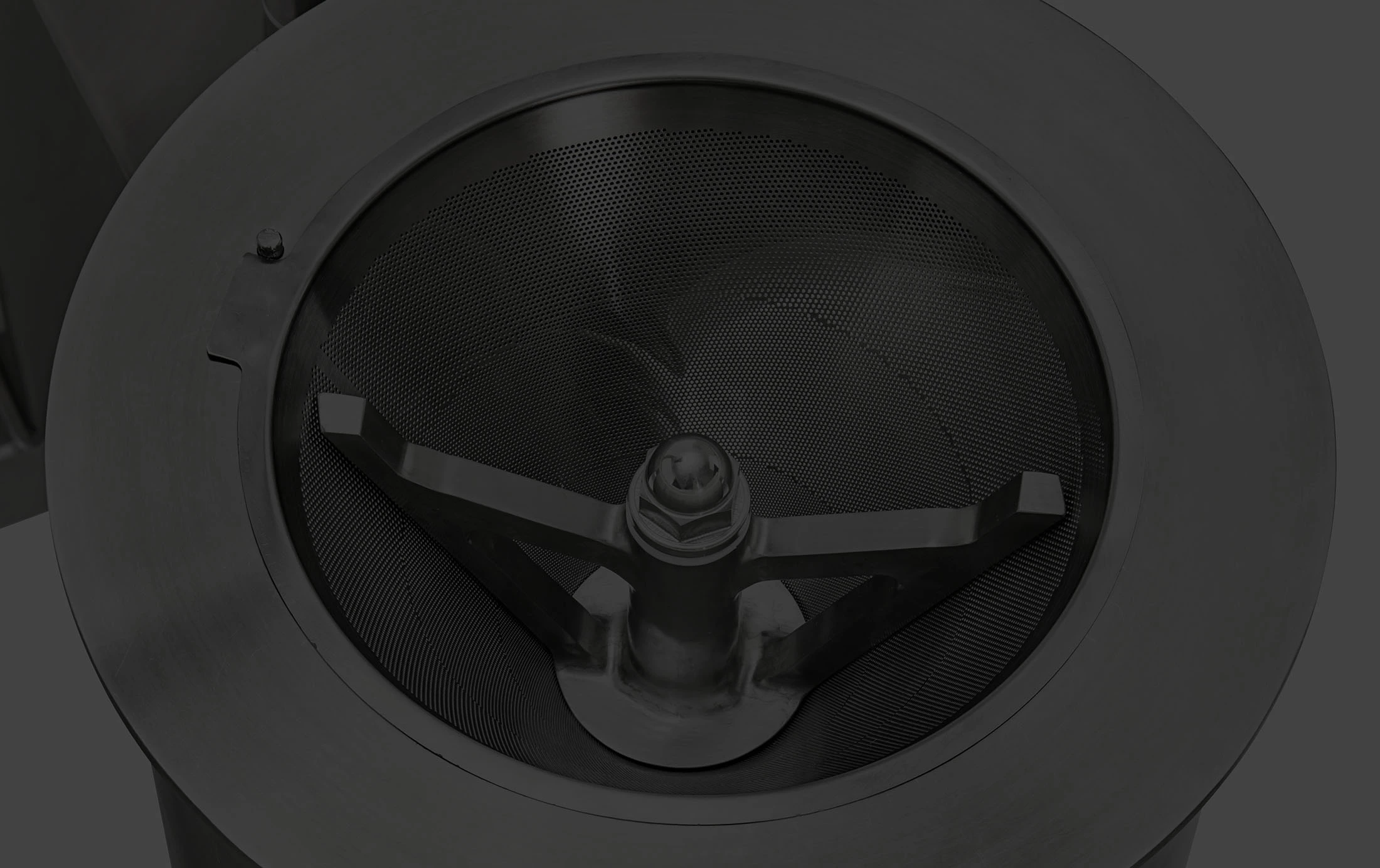


Cone mills don’t process every type of powder in exactly the same way, and most of that is down to the properties of the material being fed into the mill.
While one material can be fed easily into a mill and clear the screen as soon as the particles reach the right size, another may start sticking to the tooling or binding.
These differences add up, increasing the frequency with which production has to be stopped so mills can be cleaned.
While ‘cohesive’ and ‘free flowing’ are useful terms, there are other factors that affect the behavior of these materials. Any good powder process starts by understanding said behaviors before selecting the type of mill set-up, especially if the powders are cohesive.
We’ll explain here how the flow of powder can affect cone milling as well as show you what should be examined when a process becomes unstable.
Why are some powders cohesive and others free-flowing?
Cohesion is a measure of how strongly particles resist movement and separation
A free-flowing powder is just that, one which moves easily under its own gravity because the particles move around with relatively little resistance. This behavior means it's more likely to leave the conical mill screen once it's reached the required size.
More cohesive powders hold their shape, cling together and will resist movement through a screen even if those particles are small enough to pass through it.
The best way to separate them is to simply look at how they behave. If the powder pours consistently and forms an arc as it's poured, it's free-flowing. If it compacts during storage and clings to surfaces, it's likely cohesive.
Particle size, shape, and moisture can alter behavior
Interestingly, fine particles have a higher surface area relative to their mass, which means that surface forces have more of an influence on their movement. This can reduce the speed with which material flows around and then out of the screen.
Particles that are irregular or plate-like may interlock with greater ease and be harder to move out of a chosen screen. The shape of these particles, then, can have a direct impact on feeding and packing even when they have a similar average size.
Increased moisture can also affect the flow. An increase can cause adhesion to parts of the mill, creating soft agglomerates in even reliably dry powders.
Why flow behavior changes what happens in a cone mill
While a cone mill is in operation, the rotating impeller moves the fed material across a perforated screen, which could be square, grated, or round-holed in design. Any particles that are smaller than the aperture of the screen will pass through while larger materials remain there until they’ve been reduced.
Free-flowing materials typically reach the screen and then leave it via the holes fairly readily, which is ideal if the goal is to stabilize capacity and ensure as little time as possible in the chamber.
By contrast, cohesive materials may enter the chamber unevenly and travel as masses, sticking to the screen surface as they move around. This clinginess not only increases how long the materials remain in the chamber but also makes the particle size distribution (PSD) less consistent.
It can also increase the temperature and the number of fines present on the screen wall. All this is why engineers should consider the flow behaviors of a powder alongside the target PSD, as the mill must, at the same time, reduce the material and allow the correctly sized particles to leave efficiently.
How screen selection should differ for each powder
Free-flowing powders prefer controlled sizing
The characteristics of round hole screens mean they offer a useful balance of capacity and PSD control and are preferred by engineers because they limit the amount of fines found on the screen. They are used in several procedures, including dry milling and blending.
The screen’s hole size also has a big influence on particles and capacity. Holes with larger apertures allow coarser products to come through, while smaller openings create finer particles and may make processing take longer.
When powders already move with ease, the aim is to keep that consistent flow going without applying any more milling energy than is needed or required by the PSD specification.
Cohesive materials need a screen that keeps the process moving
Smaller hole screens may not always be the best choice when small particles are needed from the milling process because materials with a high level of moisture may quickly coat the mill before it can eject the correctly sized material.
Screens that have larger apertures can help wet or more cohesive materials pass through without too much obstruction. In our experience, we often choose square-hole screens as the most appropriate choice for wet milling because their high open areas reduce the levels of binding.
Raised cutting edges found in grater-style screens are better for harder materials that need a more proactive cutting action over a passive mill procedure.
Ultimately, the choice of screen remains specific to its intended purpose. Factors like stickiness and target PSD should all be considered rather than relying on a general assumption that all cohesive powders need the same screen.

The speed and design of the impeller must support the screen
While the screen does decide which particles leave the mill, the impeller has a big say in this also. Its speed and profile impact how the material is presented to the screen.
Impellers for free-flowing powders are often designed to move the material evenly across the screen without reducing or causing any costly breakages to particles that are already the right size. Cohesive materials need a more proactive impetus so that they don’t accumulate in the chamber.
This accumulation, however, isn’t always solved by just increasing the speed of the impeller. While a faster impeller increases how quickly the particles break up, this same speed can also increase fines and temperatures. If the product is prone to being sticky as the temperature rises, then the additional speed may actually worsen the obstruction.
The clearance of the impeller along with its profile and the feed condition should all be reviewed together rather than assuming it is one element causing the entire problem.
How to diagnose common cohesive-powder milling problems
- Screen binding: This issue occurs when the powder blocks the perforations faster than it can pass through the apertures. Surface moisture or a soft product can both lead to screen binding.
- Bridging: This particular problem is a feeding issue rather than something to do with the mill. In this scenario, the powder forms an arch in the hopper outlet, which stops it being fed into the mill consistently.
- Reduced throughput: A batch not leaving the mill quickly enough may indicate that the material is coating the screen as it warms and moisture levels increase.
- Fines increase: The issue here may be that the product is spending too long in the chamber or that the impeller speed is too high. Selecting too small a screen could also be an issue, as it may not have sufficient open area.
- Downstream issues: An acceptable PSD that flows poorly at later stages of production should prompt engineers to examine the fine fractions and distribution width.
Deagglomerating powder should make it easier to work with later on
The main goal of deagglomeration is not to grind every particle down to a smaller size but to break up unwanted clusters so the feed is more consistent and can be easily used in the next process stage.
Removing those clumps of agglomerate ensures the powder is uniform and helps in later processes such as tableting. However, over-milling can undermine the improvement if the knock-on effect is an increase in fine fraction or changes in the PSD beyond the required formulation.
Quadro’s cone mills are used for size reduction and deagglomeration, with the components - screen and impeller, for example - controlling how the materials are broken and classified.
The best results ultimately depend on the condition the powder needs to be in for the downstream process, not the most aggressive size reduction the mill can achieve.
Consider how the powder behaves when building the mill
Cohesive and free-flowing powders are very different in how they are fed into and move across the screen. While the latter flows more evenly, the former often needs closer attention paid to it.
No matter the issue currently being faced, engineers must first identify where the restriction occurs before changing a single parameter.
The most dependable configuration is found by testing the material against desired PSDs and downstream performance rather than relying solely on the powder type.