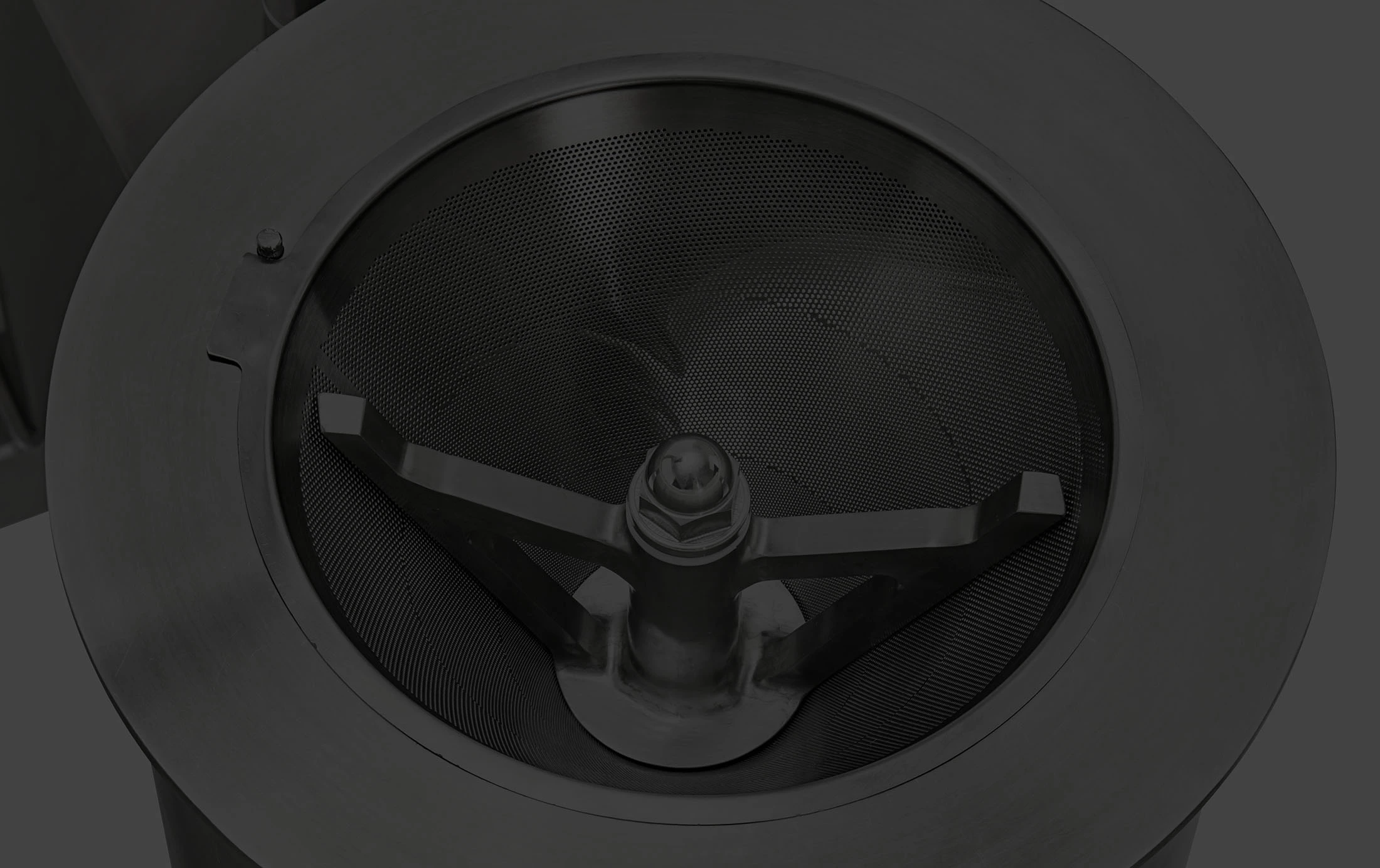


It's common knowledge that both conical mill screens and impellers will wear over time. They are, after all, consumable tooling. Premature damage, however, can almost always be avoided through better operating and maintenance practices.
The key is not to think of the screen and impeller as unrelated spare parts but as two sides of the same coin that work together inside the milling chamber, with the condition or fit of one affecting the performance of the other.
Effective preventive maintenance begins long before cleaning, and in this latest guide, we’ll explain where avoidable wear begins and offer a practical routine for protecting tooling for as long as possible.
Begin by distinguishing between normal wear and preventable damage
If a mill is regularly processing hard or abrasive materials, then it's not surprising to see gradual wear across a surface that is heavily used.
However, damage or undue wear that is concentrated in one area should become cause for a closer inspection, as this anomaly may be a sign that the impeller is misaligned and is causing unintended contact that will speed up wear.
Whether it's regular wear or more specific issues, the condition of the tooling should never just be just judged by how long it's been in service. There are simply too many other factors that can affect it.
When inspecting, compare each one with an accepted baseline. Using photographic evidence, for instance, can make it easier to identify whether or not the condition of a screen or impeller is changing.
Changes in particle size distribution or throughput may also result from the feed conditions or altered machine settings, and whilst tooling alone shouldn't automatically be blamed for the resulting process symptoms it should be explored.
The bottom line is to treat unexplained wear as a reason to investigate rather than an immediate reason to replace the same component.
Understand where screen and impeller wear begins
The product can significantly impact screen and impeller wear
The characteristics of the product can and do affect how aggressively the tooling wears. A cone mill configured for soft agglomerates may wear at a faster rate when it's used to break down a harder, more crystalline material.
Products which are moist also create another problem by sticking to the screen and obstructing the apertures. The product, as a result, spends too long in the cone mill, and rather than assessing the product, operators may be tempted to simply speed up the impeller or change the feed rate, neither of which will work.
Operating conditions will affect how quickly the tooling wears
The speed of the impeller can obviously affect the movement of the material and influence the size of the particles, if it seems that speed is indiscriminately increased as a knee-jerk response to falling throughput, its condition should be reviewed. Any change in impeller speed should be treated as a controlled change to the process.
Inconsistent or excessive feed can also prevent the mill from processing the material steadily, which can lead to accumulation and repeated particle contact inside the chamber, making wear harder to interpret.
Before focusing solely on tooling, check the complete process, as a partially obstructed screen, for example, won’t necessarily be fixed by making the impeller go faster, it will need a different solution.
A six-point tooling checklist to protect tooling while the mill is running
1. Confirm configuration
Before the process even starts, confirm that the correct screen and impeller setup has been selected for the product being milled and the target result. Changes in screen aperture or shape (round-hole, grater-hole, or square-hole screens) can all affect the milling action and how finely the particles are ground.
2. Inspect components
Inspect the cone mill screens and impellers before fitting. If a new screen is being introduced to the process then the existing impeller should also be checked to ensure its condition won’t affect the new component.
3. Assemble tooling
The tooling must then be assembled exactly as specified for the mill model. Improvised spacers should not be substituted, nor should components be forced into positions that don’t work. There shouldn’t be an assumption either that just because tooling fits into the chamber, it's correctly matched.
4. Check mill
Ensure that the machine is clear and that the tooling can move as intended before putting the product through.
5. Keep conditions stable
Keep feed conditions stable as the process begins. Any sudden surges in feed delivery can put undue stress on the cone mill and impeller that wasn’t considered prior to the process starting.
6. Investigate anomalies
Unusual noises, vibration, or excess temperatures should be a cause to begin a prompt investigation. Waiting until after the procedure is finished to check may allow small issues to increase tooling wear.

Clean tooling without creating new damage
Post-milling cleaning may be seen as a purely positive opportunity to prevent wear, but if it is done incorrectly, further damage can be caused.
Removing impellers should be done following the specified procedure, and any screens should be supported as they’re lifted out of the milling chamber. Thin, finely perforated screens are particularly vulnerable to drops, bumps, or scrapes if they aren’t held correctly.
Any cleaning should be done using approved methods so as to clear residues and any obstructed apertures without enlarging openings or damaging raised edges found in grater-hole screens.
If particularly stubborn material is found in the screen apertures, then avoid using sharp tools that can cause further unseen damage. Even a slight nick or scratch can alter the working geometry of a screen. Once cleaning is complete, reinspect the tooling now that the material has been removed. Engineers can assess the newly exposed surface.
After inspection, dry the components fully, as residual moisture can affect the behavior of the material in the next cone mill process or the condition of the tooling. Finally, throughout the cleaning process, keep tooling identification with the components to avoid mixing similar-looking screens or impellers. Doing so can lead to the wrong combination being fitted during reassembly.
Store and track screens and impellers as if they were production-critical assets
Storage and containment of tooling play just as important a role in the operating life of impellers and cone mill screens as cleaning and correct usage. Clean tooling should not be left loose. Instead, dedicated storage that protects it from accidental contact should be used.
Screens in particular are very fragile and must not be distorted by being stored incorrectly. Keeping impellers secure so their working edges cannot damage other components is also advised.
Tracking components is a vital part of preventing wear and which can be done by labeling each component clearly so that similar tooling isn’t mixed up. Records connect the tool to its part references, mill model, as well as any controlled application assignment used on site.
If tooling life is a concern, then exposure to production cycles should be recorded alongside calendar age so that the full life cycle of the part can be understood by engineers.
Lastly, any spare cone mill screens or impellers should be rotated in use via a controlled system. Unverified components that have been stored for years shouldn't automatically be considered ready to use.
Implement preventive maintenance based on inspection history
Fixed inspection programs are a great starting point to prevent wear, but as more information about part use is gleaned, the frequency of inspections can be refined.
If a more abrasive material is being introduced to a mill, then it might be useful to shorten the inspection interval so that any changes can be identified before they develop into something bigger.
Documenting what the tooling looked like pre- and post-milling creates a consistent inspection record and makes gradual deterioration easier to recognize than a binary ‘Pass’ or ‘Fail’ system.
Link tooling records with process data where possible, as changes in particle size distribution (PSD) or fines levels can indicate increased wear. Having this to hand makes intervention far easier.
It's clear that cone mills and impellers aren’t going to last forever, nor should they. The purpose of monitoring is to achieve a predictable service life without putting the parts or the wider process at more risk than is warranted.
Why genuine OEM tooling can reduce avoidable wear
At Quadro, we designed the original Comil back in 1976 and have continued to develop advanced conical milling technology ever since. Decades of knowledge mean our aftermarket team has access to intended machining and tooling specifications for a range of supported equipment.
Genuine tooling provides a known reference when investigating wear or process drift, in contrast to an unverified third-party component, which comes with less certainty around dimensions, materials and finish.
Tooling presented as being a precise fit should still be treated as a risk control, as this claim is no guarantee of unlimited service life. Wear is still inevitable. Even correctly manufactured tooling will degrade if exposed to unsuitable products or unplanned operating conditions.
Longer tool life comes from controlling the whole process
The life and wear of cone mill screens and impellers are shaped by the entire cycle, and no single maintenance action will compensate for a failure in the tooling combination or an unresolved operating problem.
Begin by reviewing unexplained wear patterns and reassess whether the screen and impeller are correctly matched.
Comparing current tooling history with the application and operating settings would be another useful next step. Finally, where wear remains difficult to interpret, involve the OEM before components are replaced.