Even with the most experienced process managers, terms like grinding and milling are sometimes used loosely or interchangeably. And while cone milling, grinding, granulation, and sieving are all distinct processes, their terminology is often blurred because one batch of material may pass through several of them during manufacture.
Even with their defined categories, which we’ll explore in this blog, there remains an overlap. Grinding, for example, can be considered a form of milling if the particles required are of a certain size, while a mill can also be used to size granules created earlier in the process.
Knowing the difference between each definition makes it easier to identify which one belongs at each stage of production.
Why do milling, grinding, granulation, and sieving get confused?
The terms can be confused as they are all involved in particle size management for powder processing. The close proximity of each of these processes within one manufacturing run means they overlap, especially in scenarios where mills contain screens or if milling follows granulation.
They are discussed together because they all influence how powders or granules behave later on in the process, but do so in vastly different ways.
Conical mills will use a screen to help reduce the size of the particles, but this does not make milling and sieving the same operation because the mill is applying a force of sorts to change the particle size before it can leave the screen.
A handy way to distinguish the process is to ask whether they are:
- Reducing particle size
- Enlarging particles
- Separating material
Size reduction vs size enlargement vs separation — the key distinctions
| Process | What Happens to the Material? | Main Purpose |
| Milling | Larger particles are mechanically reduced in size | - Controlled particle-size reduction - Deagglomeration |
| Grinding | Material is reduced in size towards a finer particle-size target | - Producing finer powders that milling alone cannot achieve |
| Granulation | Smaller powder particles are combined or compacted into larger granules | - Particle enlargement - Creating granules with certain processing properties |
| Sieving/ Screening |
Material is separated through a defined opening | - Classification - Removal of oversized material - Security screening |
What is milling?
Milling is a particle-size reduction process that takes larger particles and breaks them down to a smaller required size to achieve a target particle size distribution (PSD). The goal with milling is to get the material to a controlled size, not just to make a material as fine as possible. This is a key difference between standard milling and fine grinding, which we’ll discuss later.
How does milling reduce particle size, and how does conical milling work?
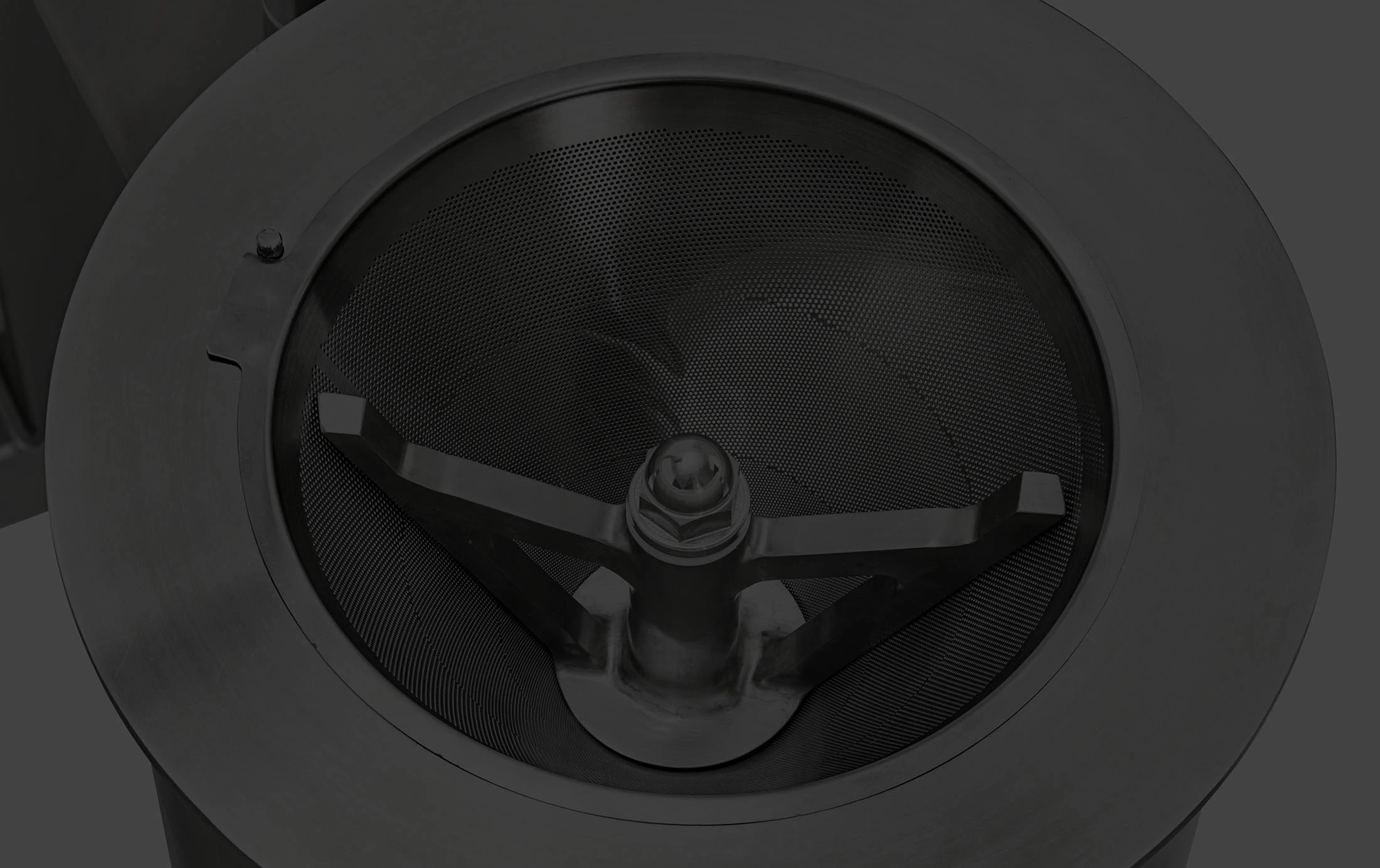
In a typical conical mill, a material is poured into the chamber, which consists of a rotating impeller and a conical screen.
The impeller arm moves the material across the screen and applies a mechanical action that reduces the material to the appropriate size, allowing it to pass through. Oversized particles remain there until they are reduced.
The components in a conical mill, as well as their setup, mean this process should be thought of as a controlled processing operation.
What is milling typically used for?
Milling can be and is used for a lot of different purposes, such as:
- Reducing the size of material to increase surface area, enhance dissolution rates
- Breaking down agglomerates and conditioning powders for consistency
- Bringing granule sizes into a more consistent range for a tight PSD
Their multiple uses mean conical mills are found at several points in powder processing, including resizing wet granules that are due to be dried out, and dry granules that are to be tableted.
What is grinding, and how is it different from milling?
Here is where the terminology gets a little tricky, as the terms overlap quite significantly. Milling and grinding do reduce particle size, which makes their distinctions less obvious than milling and granulation or sieving.
In the context of powder processing, grinding is often chosen when the goal is to create substantially finer material. Milling is different from grinding because it covers a broader range of materials from coarse sizing and deagglomeration through to very fine particle size reduction.
Where does fine grinding sit relative to standard milling?
Fine grinding takes particle-size reduction beyond a range that conventional milling operations can achieve. Quadro’s own F10 Fine Grind is designed for micron-range applications, including D50 targets of 5-45 µm.
Whereas a conical mill uses the same mechanism to achieve a given size, the F10 combines particle-to-particle size collisions with impact forces.

When would you choose grinding over milling?
Choosing which process to reduce your particles with should always factor in the desired particle size. Standard milling may be perfectly suited for controlled sizing or deagglomeration, whereas fine grinding becomes a more appropriate candidate if the material needs to be ground to a much finer powder.
As well as the requirements, the way the material behaves also impacts which one is chosen. Never rely on just the terminology and their definitions when determining which process to pick. The PSD and product behavior should define the process.

What is granulation?
Whereas the processes we’ve described so far reduce the size of particles, granulation does the opposite. It is a particle-enlargement process that brings powder particles together to form larger, more uniform particles, which are known as granules.
Granulation is used in pharmaceutical settings, in particular, as it can help to improve powder flow and reduce segregation for downstream processing.
What is the difference between wet and dry granulation?
A granulating liquid that contains a powder is used to form agglomerates in wet granulation. These wet granules are then dried.
Dry granulation makes particles larger without adding liquid. Powder is compacted into ribbons before being broken down and sized into granules.
Where do milling and sizing fit within the granulation workflow?
Granulation and milling can appear in the process and, in many instances, actually complement each other, even though, on paper, it can feel like both processes are opposites.
Granulation helps to create larger agglomerates which a later milling stage can then reduce to get them within the required particle size distribution.
In wet granulation procedures, conical milling is often used to accurately size wet material before the drying process and again if required after drying. In its sister process, dry granulation, material is compacted into ribbons before being milled to create appropriately sized granules.
At this stage, milling should be thought of as something that sizes granules, not as the granulation mechanism itself.
What is sieving (and screening)?
Sieving, or screening in some cases, is a process by which material passes across or through a defined aperture so any unacceptably sized material can be separated.
The main purpose of this procedure is to classify and/or separate particles rather than mechanically reducing the size of the particles.
What is the difference between sieving, screening, and security screening?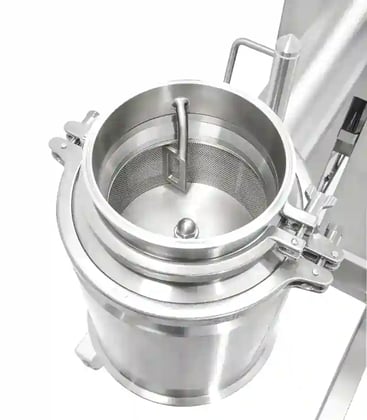
While sieving and screening are relatively similar procedures, security screening has a more defined purpose, which is to protect downstream processes by preventing unwanted particles or foreign materials from being allowed to pass.
Quadro’s FlexSift allows powder to be passed through a screen while retaining unwanted material. Any agglomerates located can be gently delumped without affecting the particle sizes themselves.
Why is sieving a separation step, not a size-reduction step?
Using a sieve does not automatically apply the mechanical force needed to fracture particles. It instead just determines which material can pass through an opening and does not change the particles.
This key distinction explains why screens can appear inside mills and sifters. In the former, it works in tandem with mechanical size reduction processes, and in the latter, its main job is to classify and retain material if needed.
How do these processes work together in a powder processing line?
All the processes outlined in this piece are often found in one powder-processing line, with each one using its distinct features to solve a different material-handling problem.
For example:
- Material might be screened and sieved for foreign objects before processing,
- Then, it would be granulated to form larger agglomerations,
- And later milled to bring the granules within the required PSD.
The sequence can differ, and there is no fixed workflow used by every process team. Where processes are placed depends on the behavior of the product and what teams are looking to get out of the entire process.
The best way to figure out what goes where is to establish if the material needs to become smaller, larger, or separated.
How does Quadro Engineering support milling, grinding, granule sizing, and screening?
The range of Quadro products means that many of the processes described here can be achieved within the wider processing sequence. Comil conical mills provide controlled particle-size reduction and granule sizing, while the Fine Grind F10 reduces particles to even finer ranges.
In addition, the FlexSift helps to separate unwanted oversize or foreign materials without turning the screening process into one that further grinds the particles down.
Selecting some or all of these products starts with the goals of the process followed by testing.
Start with what needs to happen to the particles
While initially confusing, the terminology becomes far easier to navigate once each operation has been clearly defined. These processes frequently complement one another in a real manufacturing process and become much easier to select and order when key goals have been outlined.