While on their face, milling and micronization sound like the same process because they ultimately achieve the same goal, particle size reduction, they are, in fact, not interchangeable processes.
Selecting between them is not as simple as deciding whether powder X needs to be made “fine” and “not fine”.
Conventional mechanical milling is well-suited to products that require controlled sizing or a defined powder distribution, whereas micronization focuses on producing substantially finer particles. And between these two processes sits fine grinding, which achieves particle sizes that conventional conical milling cannot, without automatically requiring a jet-milling process.
As may already be apparent, the terminology can be confusing. This is in part because there is no single particle-size boundary that separates milling from micronization.
In our latest guide, we’ll compare the mechanisms and trade-offs so process teams can better identify which route deserves testing.
What’s the difference between milling and micronization?
Milling is the broader category of particle size reduction and covers technology that uses mechanical forces to reduce the particles.
Micronization describes processing that produces material at the ultra-fine end of the micro scale. It is commonly associated with jet milling.
While it is good to define each process and explain their differences, the key distinctions only become useful when they are tied to a measurable PSD.
Are the two terms interchangeable?
They are both forms of comminution (the term that describes the process of reducing particle sizes) and produce particles that can only be measured in microns.
In micronization’s case, the term also describes the particular machine type as much as the outcome, further adding to the distinction.
That similarity in outcome means it would be inaccurate to describe all the processes as “micron-scale milling” because it fails to establish whether it’s:
- Conventional milling,
- Fine grinding,
- Or true micronization.
How particle size (microns and D-values) separates the two
While seeming definitive, a single particle size can hide important aspects of its specification. For example, a D50 of 10 µm (a micrometer) means something very different from a D90 of 10 µm.
Why? Well, because the D50 reading represents the median of the distribution, while D90 highlights the size below which 90% of the measured sample volume falls.
This is an important distinction when comparing technologies, as a mill that is capable of achieving a low D50 may still leave a coarser upper end of its distribution when compared to an application requiring a similarly low D90.
A quick guide to the PSD terms
| Term | What It Tells You |
| D10 | The size below which 10% of the sample volume falls |
| D50 | The median particle size where 50% of the sample volume is below it. |
| D90 | The size below which 90% of the sample volume falls |
| PSD | The total PSD, not one isolated particle size number |
What is milling, and what particle sizes does it achieve?
The term milling covers a broad range of technology and intended results, meaning any PSD depends on the type of mill. Therefore, referring to the process as simply “milling” fails to take into account those differences.
How does conical milling work and what size range does it target?
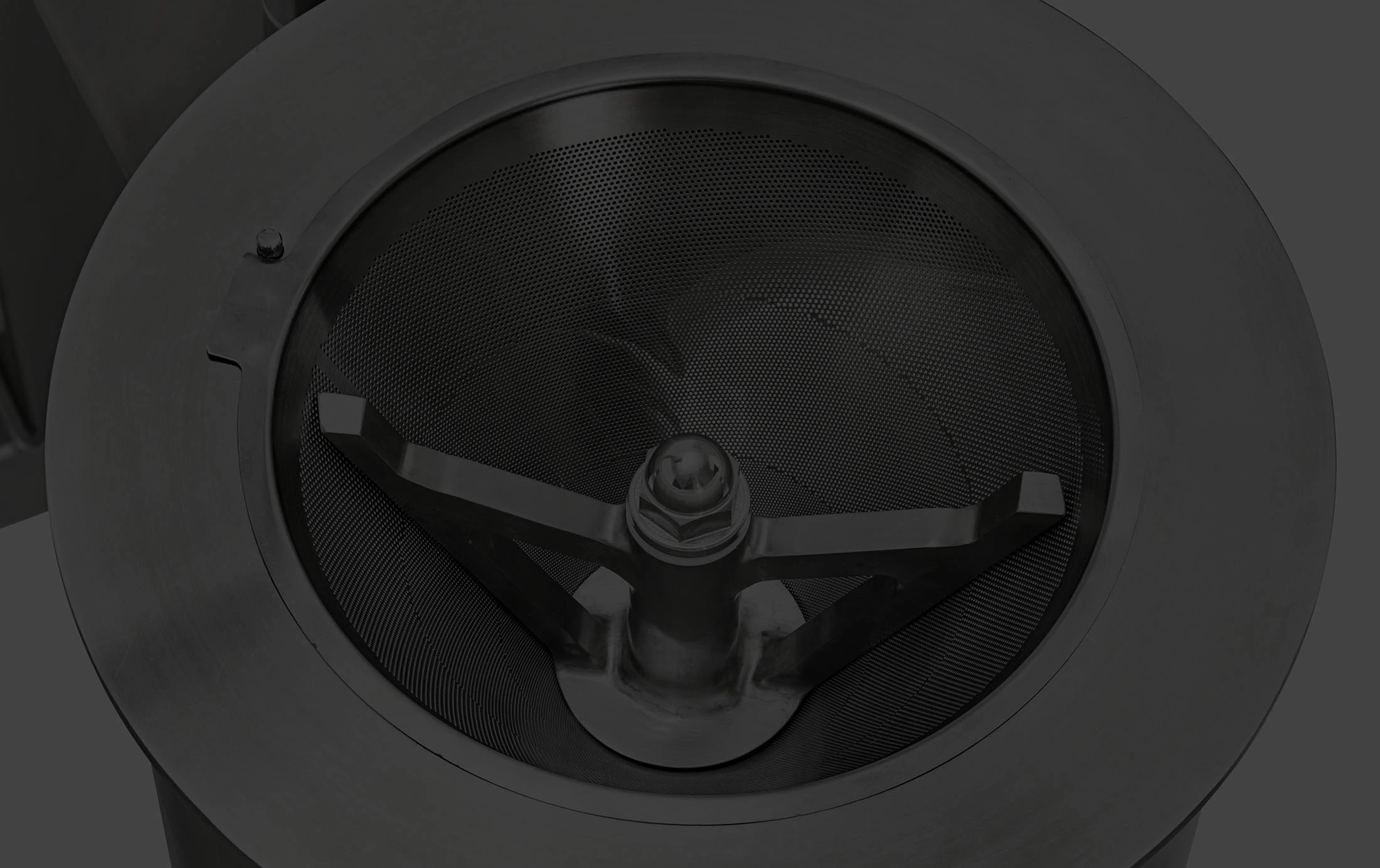
A conical mill is made up of a rotating impeller that moves material, a powder of some sort, towards a fixed conical screen that can be composed of circular holes, square holes, or raised edges.
Material is reduced to the intended size before being able to pass through the screen and leave the milling zone.
Conventional cone milling is well suited to controlled particle size and deagglomeration. Our standard Comil applications can reduce material to around 180 µm, though it does depend on materials, tooling, and processes.
Conical milling is a logical start if the end product does not require too fine a distribution.
Which applications are best served by milling?
Milling is often chosen if the objective is to create a PSD that is easily repeatable.
Typical requirements include:
- Sizing powders or granules
- Breaking agglomerates
- Conditioning material for a downstream manufacturing stage
- Achieving a target PSD
- Improving homogeneity
Coarser PSDs, toward the 180 µm range, help to ensure the powder is easy to handle, something that can be affected if particles are too finely ground, which can create downstream consequences, in addition to extra processing.
What is micronization, and what particle sizes does it achieve?
Process teams opt for micronization when the product requires a particle size that is beyond what can be achieved through conventional mechanical milling. Jet milling is one form of micronization and can operate in ranges where individual microns are key to product performance.
How does micronization (e.g., jet milling) work?
Jet mills accelerate particles to a high speed using compressed gas. By doing this, particles collide and reduce in size, which is different from mechanical milling that forces product through a screen.
Jet milling can reduce material down to approximately 1-10 µm and, because there is no grinding component, the requirements differ substantially from mechanical milling, including a greater demand for compressed gas.
Which applications genuinely require micronization?
Micronization is preferred in scenarios where the particle size has to be finer because it's connected to a requirement of the product.
In pharmaceutical settings, micronization can increase surface area and improve dissolution rates and bioavailability, helping to support formulation homogeneity and/or specialized delivery routes. Jet Milling is commonly used for Pharma APIs and dry powder inhalers.
Coarser milling should not be used if the performance of the project hinges on a truly micronized range, even if its distribution reaches single-digit microns.
Is there a middle ground between milling and micronization?
There is a middle ground between the two processes, and it is often chosen when applications need a finer PSD than a conical mill can achieve but not necessarily the single-digit targets that jet milling achieves.
Fine grinding, as it's called, occupies the middle ground. However, it is still important to test the material, as the usable range can and does overlap with micronization numbers, rather than ending at a neat boundary.
How does fine grinding fill the 5–45 micron gap?
How fine grinding achieves this is best illustrated through Quadro’s own F10 Fine Grind, as it is able to achieve that intermediate capability. It can achieve performance targets of D50 in the 5-45 µm range, and D90 targets around 20-60 µm.
Fine grinding can then ensure a mechanical reduction of product to considerably finer levels than that of a conical mill without needing to achieve said PSD through jet micronization.
This overlap is exactly why milling technology should not be selected from a micron figure alone because a requirement for D50 at 10 µm is a different process problem from D90 at 10µm.
How do heat, yield, cost, and material properties influence the choice?
Moving down the µm scale toward finer and finer sizes impacts the processing of the material significantly. How easily particles can fracture to those finer microns is impacted by how hard or friable the material is, while heat sensitivity affects the amount of energy that can be safely introduced.
Even after processing, the finer powders continue to behave differently. After micronization, the particles may have increased surface energy or changed morphology, which can affect solid-state characteristics in pharmaceutical applications especially.

When do you need milling, fine grinding, or micronization?
The process that creates the finest possible PSD is very often not the right approach. The better approach would be to understand the product requirements and then work backwards to find the right technology.
How to match the method to your target PSD and product requirements
-
Conventional Milling: This method is most logical if controlled sizing or deagglomeration within a relatively coarse range will work with the product and any associated downstream processes.
-
Fine Grinding: If the PSD moves far below what a standard conical mill can achieve but the specification doesn’t state whether the product needs a genuinely micronized D90, then fine grinding deserves consideration.
-
Micronization: Process teams should think about using this method when the product's performance depends on how fine the distribution is, one that is so fine that a mechanical mill cannot deliver it.
In the field, these categories overlap. As a result, PSD targets should be considered alongside the properties - good and bad - of the material itself.
How can Quadro Engineering help you choose and validate the right approach?
A datasheet filled with particle-size capabilities can show you what a milling technology can achieve, and trials establish what it can actually do with the proposed material. And it's this vital distinction that makes it important to consider the overlap between conical milling, fine grinding, and micronization.
The Waterloo Technology Centre supports these sorts of considerations through feasibility testing and scale-up trials. This allows Quadro customers to evaluate their equipment and process settings before committing to large-scale production.
For applications that require true micronization, beyond what Quadro’s existing milling technologies provide, the conclusion should be that a micronization process is required.
Choose the particle size you need before choosing how to produce it
Milling, fine grinding, and micronization form part of a particle-size reduction spectrum and should be thought of as such, not three separate, clearly defined categories.
Knowing the PSD and what is needed in order for the product to perform is the first step and is followed by narrowing the process down based on material behavior and the practical elements of manufacturing.
Suppose that choice is unclear. Test. Testing provides evidence that is far stronger than assumptions about conventional milling or micronization.