

Fine grinding may sound straightforward, but only until a team in charge of the process has to turn this process into an equipment specification on a factory floor.
A desired end result that is described only as a ‘fine powder’ or a nominal micron size still leaves major questions about what the acceptable amount of coarse or ultrafine material is.
Fine grinding is an advanced form of particle size reduction and is used when conventional milling cannot provide the required fineness or control over the finished distribution.
The aim of fine grind milling is to place a high proportion of the material inside a defined size range without excess heat or waste hampering the process. Here, we’ll break down fine grinding, both the process and the motivation behind doing it.
Fine grinding is defined by the desired result rather than a specific micron
Fine powder grinding is a process that reduces a feed material into a substantially finer powder and is often used when control of the finished PSD is as important as the nominal particle size.
There is no specific number or range used to define whether something is ‘fine’ or not across different industries or materials. One supplier may choose a fine grinding mill for powder below 100 microns whereas another may reserve that for targets that are substantially smaller.
The subjective nature of this process means engineers should treat these terms, such as ‘fine’ but also others like ‘ultrafine’ and ‘micronized’, as useful categories rather than defined technical specifications.
This is why narrow particle size distribution is usually expressed in microns, which indicate the dimensions of the particles themselves, or in mesh, which refers to the size of the sieve openings used to classify them.
Higher mesh numbers mean a finer sieve because more openings are packed into each inch. Despite this, mesh and microns are not exactly the same measurements so shouldn’t be treated as interchangeable.
The important figure to note for the Quadro Fine Grind F10 is its D50 PSD range of 5-45 microns which is referred to as being below the 325 U.S. standard mesh. For context, D50 means that half of the measured particles are smaller than that figure and half are bigger.
D50 is only the midpoint of the powder
What D10, D50, and D90 reveal
As mentioned earlier, D50 is the median particle diameter and shows that half of the measured particles are smaller, while half are larger. D10 and D90 are helpful because they show what is happening at the finer and coarser ends of the distribution.
Using these two values provides a more useful picture than relying on the D50 figure alone. Because while two batches can share the same D50, they may contain two very different quantities of oversize particles and unwanted fines which can affect downstream behavior.
A final specification should therefore identify the part of the distribution curve that's critical to final product performance instead of assuming one median figure is representative of the entire powder.
Why narrow PSDs can matter
Narrow PSDs indicate more of the batch is concentrated closer to the intended target and that there is less material in the coarse or finer categories. A narrower PSD may support future downstream applications, its usefulness depends on the application.
Analyzing PSDs and collecting samples should also remain consistent because procedures such as sieving and laser diffraction can measure a narrow particle size distribution differently and should not be treated as interchangeable as a result.
Why manufacturers sometimes fine-grind powders
Reducing particles to a size that could be considered a fine grind increases their available surface area, which can change how they dissolve, react, or release flavor and color, in some instances.
Those in pharmaceutical development may fine-grind powders to influence dissolution and bioavailability in scenarios where absorption is dissolution-limited. It can, however, affect stability so a smaller particle size should not be thought of as automatically superior. The FDA advises controlling PSD when these properties are affected.
Food and nutraceutical manufacturers may opt for a fine grinding mill to alter texture and mouthfeel, whereas those looking to use powders in chemical or personal care may require a fine, controlled product for a more consistent appearance.
Whatever the reason behind fine grinding, it should always be linked to a defined functional requirement because without this, the outcome can increase processing difficulty without creating any real value.

Fine grinding depends on the material’s behavior in the mill
Size reduction can come from controlled stress
Industrial cone mills will use a combination of forces to reduce particles, and the appropriate combination depends on how the material fractures and what distribution is required.
Materials which are more brittle tend to break more readily than their fibrous counterparts and soft products may deform instead of fracturing while abrasive powders can accelerate the wear of the grinding equipment.
And while increasing speed or the amount of energy may create finer particles, this relationship is not always linear. Once a material starts to behave poorly, either by agglomerating or recirculating, that additional energy can reduce the yield, not improve it.
A two-stage reduction can improve control
A two-stage process first conditions or disperses the feed before the main fine-grinding stage. This action reduces the size variation before it enters the final action zone.
A more consistent feed into the second stage can reduce the gap between coarse particles and the target fraction, which improves the proportion of product that finishes within the specified range.
Other factors include heat, airflow, and dust
The mechanical energy needed for a fine grinding mill creates both particle breakage and heat which may soften or smear heat-sensitive materials if the temperature is not controlled.
Correct circulation of air can assist cooling and product transport, while the collection system must handle fine powder grinding without restricting the process.
Dust control and cleanability should be evaluated to the same extent as particle size and throughput before the mill configuration is chosen.
Which powders are good for a fine grinding mill?
Typically, dry and friable materials that flow easily are the most obvious candidates for mechanical fine grinding because they break apart readily and move through the system.
Less suitable materials include those that may be oily or sticky, or are characterized by high elasticity or electrostatic behavior. No matter the characteristic, any material can change the mill’s configuration or raise the need for an alternative process.
The feed condition matters as much as the chemical’s features, too. Temperature changes are just one example that can cause two identical batches of the same material to process differently.
Trials, conducted before the main powder milling process is carried out, should look to establish whether the desired D50 and distribution tails can be achieved while maintaining an acceptable throughput and temperature.
Typical Quadro Fine Grind F10 applications include:
- OSD Pharma
- Nutraceutical ingredients
- APIs
Look beyond displayed micron sizes when evaluating fine grind equipment
The lowest advertised particle size of a mill doesn't necessarily indicate how much of the batch reaches that size or how broad the PSD will be.
Comparing different fine grinding equipment should include representative material and pre-agreed acceptance criteria.
Useful results should include:
- D10, D50, and D90
- On-spec yield
- Product temperature
- Throughput
- Amount of retained and unrecovered material
When evaluating fine grind equipment, assess whether it provides the user with adequate control over feed rate, airflow and collection once the process is complete. These variables affect nominal particle size and repeatability in particular.
Any selection process should recreate the intended feed and final operating conditions rather than relying solely on published range data.
Where the Quadro Fine Grind F10 fits
The Quadro Fine Grind F10 is specifically designed for fine powder applications that require a D50 in the 5-45 micron range and high proportion of material within the target PSD.
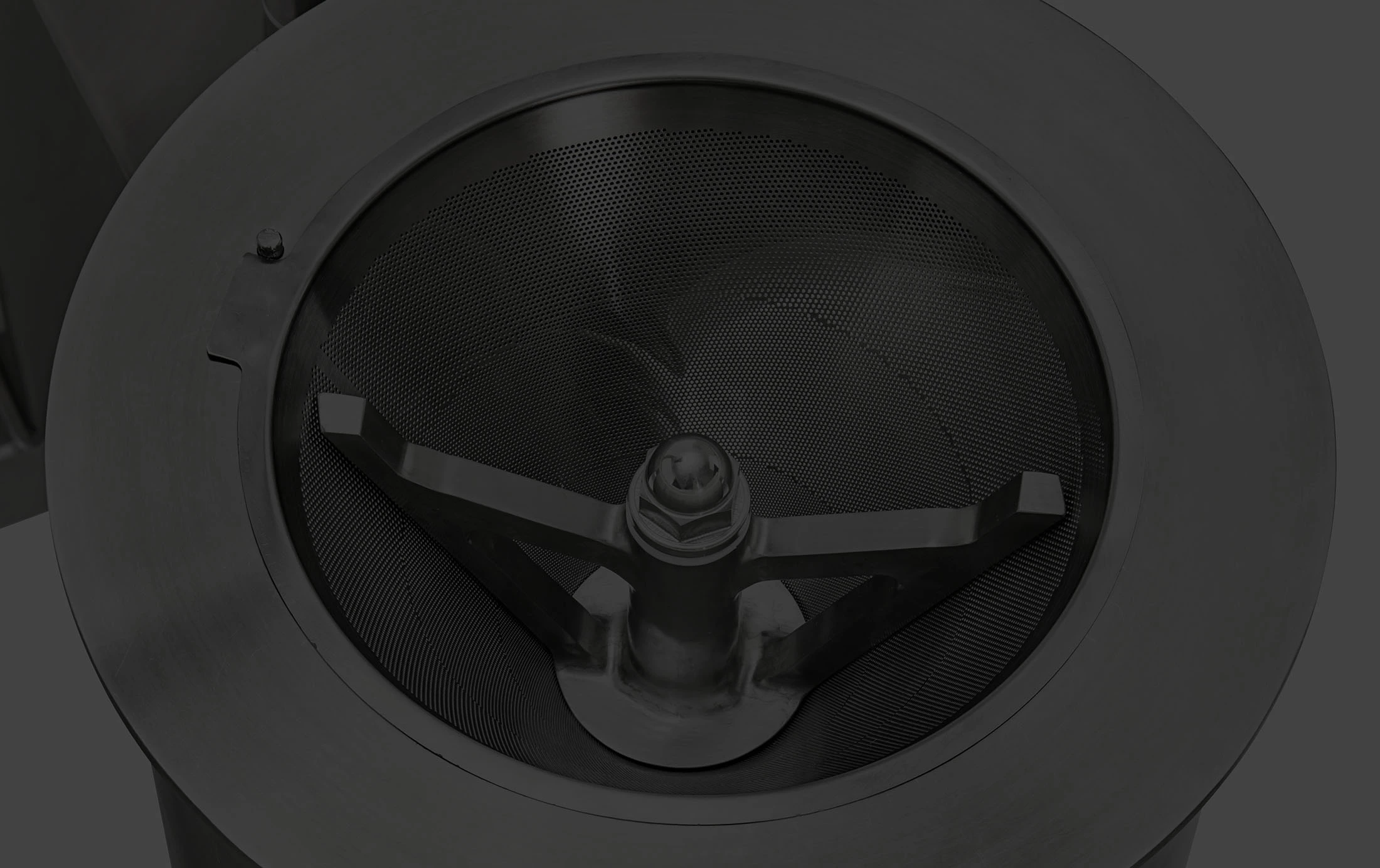
Its key feature is a two-stage size reduction that uses a preliminary chamber and a second milling stage. This arrangement produces more consistent distributions than a single-stage process would.
The F10 is an integrated, standalone piece of equipment that combines feeding, milling and product collection. This integration means firms can remain focused on the wider process rather than worrying about its individual elements and whether they will work together.
The Fine Grind F10 is also designed to combat the issues previously discussed in this blog. It produces low levels of heat and is constructed to be easily cleaned after each use.