

Achieving a consistent particle size distribution often presents a recurring challenge in powder processing. Many manufacturers establish a target PSD during development, but observe variation once the process moves into routine production. That can cause potentially costly delays to production, as well as placing more pressure on staff with additional quality reviews.
One of the most effective ways to control particle size distribution during routine production is through cone milling, a process we’ve helped to pioneer at Quadro MPT. The process reduces agglomerates and uses a calibrated screen to ensure that particles exit the mill within a defined size range. That can make it much easier for your staff to reduce batch-to-batch variation, and keep the particle size distribution within the validated specification for each process.
Why a narrow PSD is so important for process performance
Particle size distribution is important for process performance because it has a strong influence on how your powder or granulated material moves and behaves throughout each stage of production. A tightly defined distribution enables each downstream step to operate under consistent conditions: your feeders can deliver material at a stable rate, your presses can apply uniform force, and your coating systems can achieve even coverage.
In particle size analysis, distribution is typically denoted using percentile values such as D10, D50, and D90. Each value represents the particle size below which a specific percentage of particles in the sample fall.
- D10 identifies the particle size below which 10 percent of the particles in the sample occur
- D50 represents the median particle size, where half of the particles fall below that diameter
- D90 marks the particle size below which 90 percent of the particles occur.
So, since a controlled D10 to D90 span defines the range between the smallest 10 percent and largest 90 percent of particles within a sample, this can help to give your engineers a clear view of distribution width and consistency. A tighter span can give you confidence that the material’s compaction behavior remains consistent throughout the tablet compression process, helping it to achieve a stable tablet weight and finish.
Consistent particle sizing has a strong effect on content uniformity and dissolution profiles in pharmaceutical oral solid dose manufacturing, so if you work in this sector, your equipment needs to deliver that consistency to meet regulatory expectations for uniform dosage units and dissolution performance described by the United States Pharmacopeia and the European Directorate for the Quality of Medicines.
If your organization operates in food or nutraceutical production on the other hand, your processing equipment needs to reliably produce the same particle size distribution in every batch, so that the finished product maintains consistent texture, flavor release, and dissolution behavior.
How cone milling produces a narrow particle size distribution
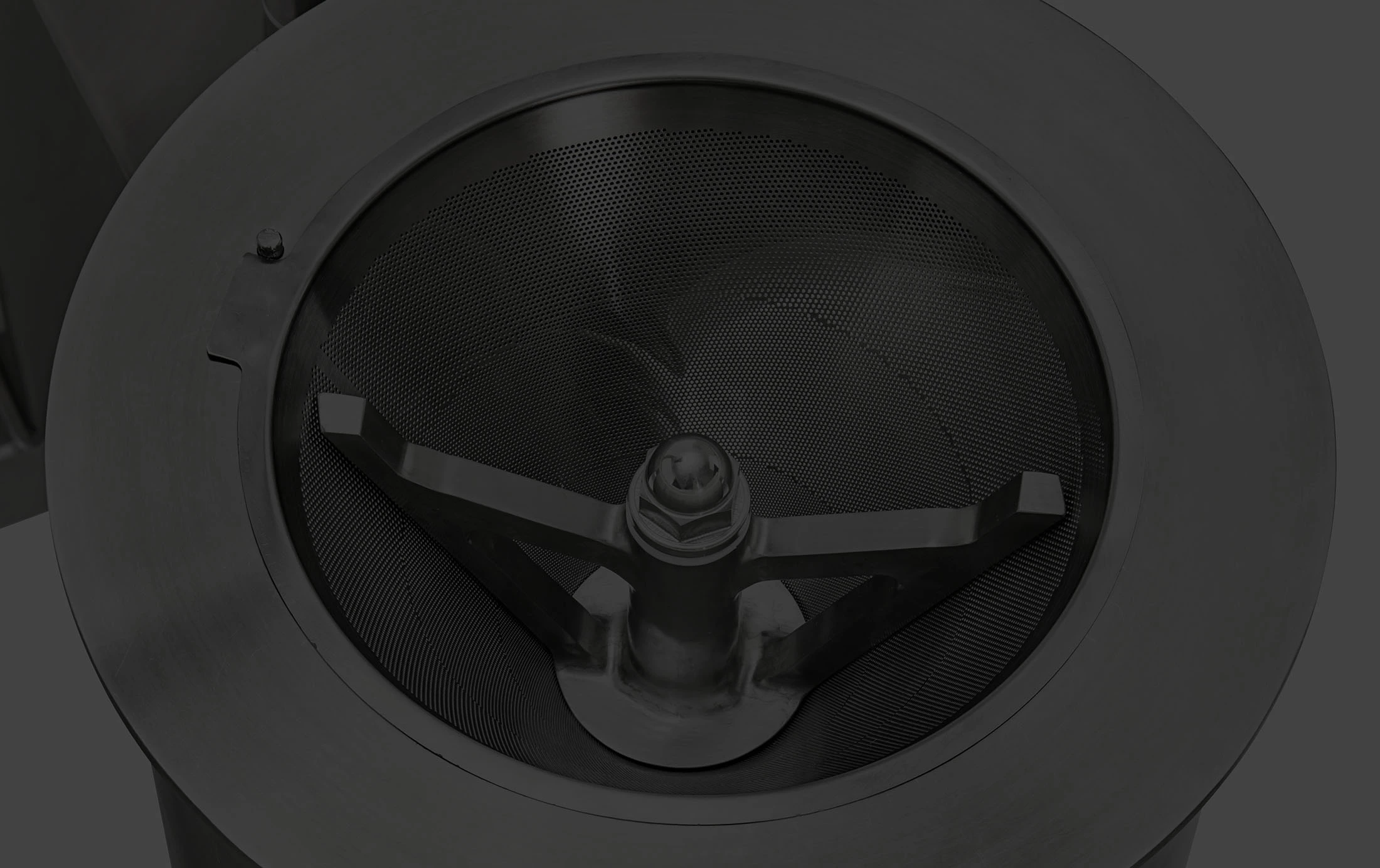
In a nutshell, cone milling produces a narrow PSD by subjecting particles to controlled impact and shear as the rotating impeller accelerates them toward the conical screen and milling zone. (The Quadro® Comil® is the original conical screen mill - it was invented by our team in 1976, and ever since then it’s been the industry standard for half a century.) So, having briefly covered a summary of the process, let’s now look at it in a bit more detail.
Material enters the mill and moves into the milling zone
Material first enters the conical milling chamber through the feed inlet at the top of the mill. In many applications, this feed material may consist of agglomerates or irregular particles that require conditioning or deagglomeration before further processing. Once inside, the particles move into the processing zone where they interact with the rotating impeller and the surrounding conical screen.
Particles are reduced in size as they move across the screen
Centrifugal force and repeated contact with the rotating impeller then guide particles across the surface of the conical screen. The rotating impeller also sweeps material across the screen surface, repeatedly presenting particles to the milling interface and screen apertures. As they move through this milling zone, the particles are broken into smaller fragments through impact and shear caused by repeated interactions with the impeller and screen.
The screen controls when particles leave the mill
Larger particles remain within the milling zone until they’re reduced enough to pass through the screen perforations. Particle shape and orientation can influence whether a particle passes through a screen aperture, which means some particles may require multiple interactions before aligning and passing through the opening. The screen therefore acts as a physical control point, allowing only particles below a certain size to exit the system. This creates a consistent upper size limit and helps produce a narrow Particle Size Distribution.
The biggest factors affecting PSD
- Impeller tip speed - The speed of the rotating impeller affects the energy applied to the particles, influencing how quickly they break down and how frequently they interact with the screen.
- Screen hole size and geometry - The dimensions and shape of the screen perforations determine the maximum particle size that can exit the mill.
- Particle shape and orientation - Irregular particles may require several passes across the screen before they align with an aperture and pass through it.
- Feed material condition - Agglomerated or irregular feed particles often require more interactions within the milling zone before they reach the required size for exit.

Key variables for controlling PSD width in cone milling
| Process Variable | Effect on PSD |
| Screen hole size |
Determines the maximum particle size that can pass through the screen. Smaller holes can prevent larger particles from exiting the mill, which narrows the upper end of the particle size distribution. |
| Screen hole shape (round, square, grater) | Changes how particles pass through the screen and how fines are generated. When two screens have the same aperture size, grater-style or slotted designs often generate fewer fines than round-hole designs. |
| Impeller tip speed (RPM) | Controls how much energy is applied to the particles. When the impeller rotates faster, it applies stronger impact and shear forces, which can narrow the distribution, but may also increase heat generation. |
| Impeller profile (bar, square, round) | Affects the type of shear force applied to the particles. It also influences how the impeller directs the particles toward the screen surface. |
Achieving batch-to-batch PSD repeatability
Whatever sub-sector you work in, your process performance will rely on maintaining a consistent PSD across every batch. A process that produces the correct distribution once still needs to reproduce that same PSD consistently across multiple production runs, to ensure that every subsequent batch still meets the same specification.
Quadro’s Comil is specifically designed to provide consistent process parameters - the impeller speed can be controlled with a high degree of precision, and the quick-change screens can be swapped and relocated in a fixed position each time. The equipment also includes fixed locating features, so that after the mill has been disassembled and cleaned, the internal components can be easily returned to the same alignment and spacing.
The Comil’s design features also support process validation. This typically requires demonstrating that the same screen and impeller combination, running at the same speed and feed rate, can directly influence the PSD. The mill’s design makes that easy to do - your team can establish a defined milling setup using a specific screen and impeller combination and confirm that this configuration repeatedly produces the required particle size distribution. That can help you to maintain consistency across multiple production runs.
- If you work in pharmaceutical manufacturing, this level of repeatability can make your pharmaceutical process validation more straightforward by enabling your team to maintain fixed milling parameters - such as screen type, impeller configuration, operating speed, and feed rate.
- If you work in food or nutraceutical production on the other hand, the same repeatability can help your process maintain a consistent particle size distribution across batches. That can be instrumental in helping your products to maintain consistent texture, flavor release, and solubility.
The same consistency is also required when your process moves from development into larger-scale manufacturing. Quadro’s scalable Comil platforms allow your team to develop a PSD at lab scale using the SLS Scalable Lab System, then apply the same screen and impeller configuration on the SDx Mid-Size for pilot trials and the SDx Production Scale system for full production. This means that the same milling setup that your team establishes during lab trials can therefore be applied as the process scales up to help ensure that the same PSD is reproduced in pilot and full production environments.
Narrow PSD in practice — Application examples
Different industries apply particle size distribution control in different ways, depending on how particle size affects the performance of their finished products, and how their powders or granules behave during manufacturing.
Pharmaceutical OSD dry milling after wet granulation
In pharmaceutical processing, wet granulation produces granules that require sizing before compression. A cone mill is typically used to calibrate these granules to a defined PSD prior to tableting. Engineers will set screen size and impeller speed to achieve the required D50 and distribution span, ensuring that the material meets the correct PSD specification.
API milling
In active pharmaceutical ingredient processing, PSD can influence the dissolution behavior of the active ingredient, and the content uniformity of the finished dosage units. Amongst other things, a controlled distribution helps to ensure that each tablet or capsule contains the intended quantity of active ingredient, and that it disperses evenly throughout the powder blend during formulation.
Nutraceutical powder processing
In nutraceutical production, PSD can influence blend uniformity, capsule fill accuracy, and the final appearance of finished products. A consistent distribution helps formulation teams maintain uniformity across multiple production batches, so that each batch meets the declared ingredient quantities and product specifications required for sale.
Food ingredient milling
In food processing, PSD can influence how quickly powdered ingredients dissolve, how evenly they disperse through a mixture, and how consistently the flavors are distributed within the finished product. A defined particle size distribution helps ingredients hydrate, mix, and disperse in a predictable way during processing, helping manufacturers to maintain consistent texture, flavor distribution, and product quality across batches.
How to choose the right Comil configuration for narrow PSD
Your equipment configuration determines how effectively your process controls PSD within your production environment. Each Comil configuration is designed for specific installation conditions, process layouts, and production scales. This means your available space, process flow, and integration with upstream and downstream equipment will therefore influence which Comil configuration will perform most effectively within your facility.
Your production scale and cleaning requirements are two more key factors that will influence which Comil mill is best suited to your operations, and how your operators run that mill during routine manufacturing.
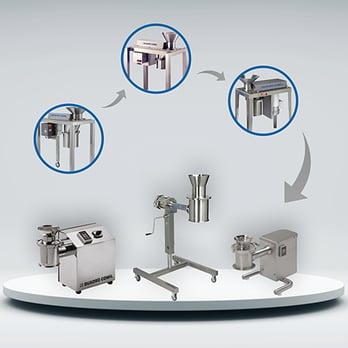
Overdriven Comil
The Overdriven Comil positions the motor above the milling head. This configuration suits production-scale environments where a top-drive arrangement can integrate with existing equipment layouts, and allow straightforward access for operation and maintenance.
Underdriven Comil
The Underdriven Comil places the motor below the milling head, creating a compact inline design. This configuration works well within wet granulation lines, and in installations where available space and upstream equipment will influence which equipment a business might choose.
SDx Series
The SDx Series provides a modular platform that accommodates multiple milling heads on a single drive unit. This setup allows process teams to switch between different milling configurations, so that the same system architecture can handle the varying demands of development work, pilot trials, and production.
SLS Scalable Lab System
The SLS Scalable Lab System provides a benchtop platform for research and method development. Engineers can define PSD parameters at lab scale and carry them into production using matched tooling, ensuring that the particle size distribution and material behavior initially developed in the lab are then reproduced consistently during the later stages of the manufacturing process.
Consistent PSD starts with the right milling technology
The key to achieving narrow, repeatable PSD is to choose a milling system that finely controls particle size, helping to ensure that you and your team can maintain the target distribution. At Quadro, our Comil technology can provide this control through engineered screen selection, impeller profiles, and speed settings, giving you peace of mind in consistent particle size across every batch.
For over four decades, our Comil systems have provided reliable PSD control in pharmaceutical, food, and chemical processing, helping teams across the UK to scale from lab development to full production while maintaining consistent performance throughout. The same tooling principles apply at every stage, helping teams to carry out PSD validation and achieve predictable and repeatable results during scale-up.
At Quadro, we can work with your team to define the optimal Comil configuration for your target PSD, ensuring that every one of your batches meets strict formulation specifications and quality standards. Speak with a specialist via the Contact Us page to identify the best solution for your production goals.