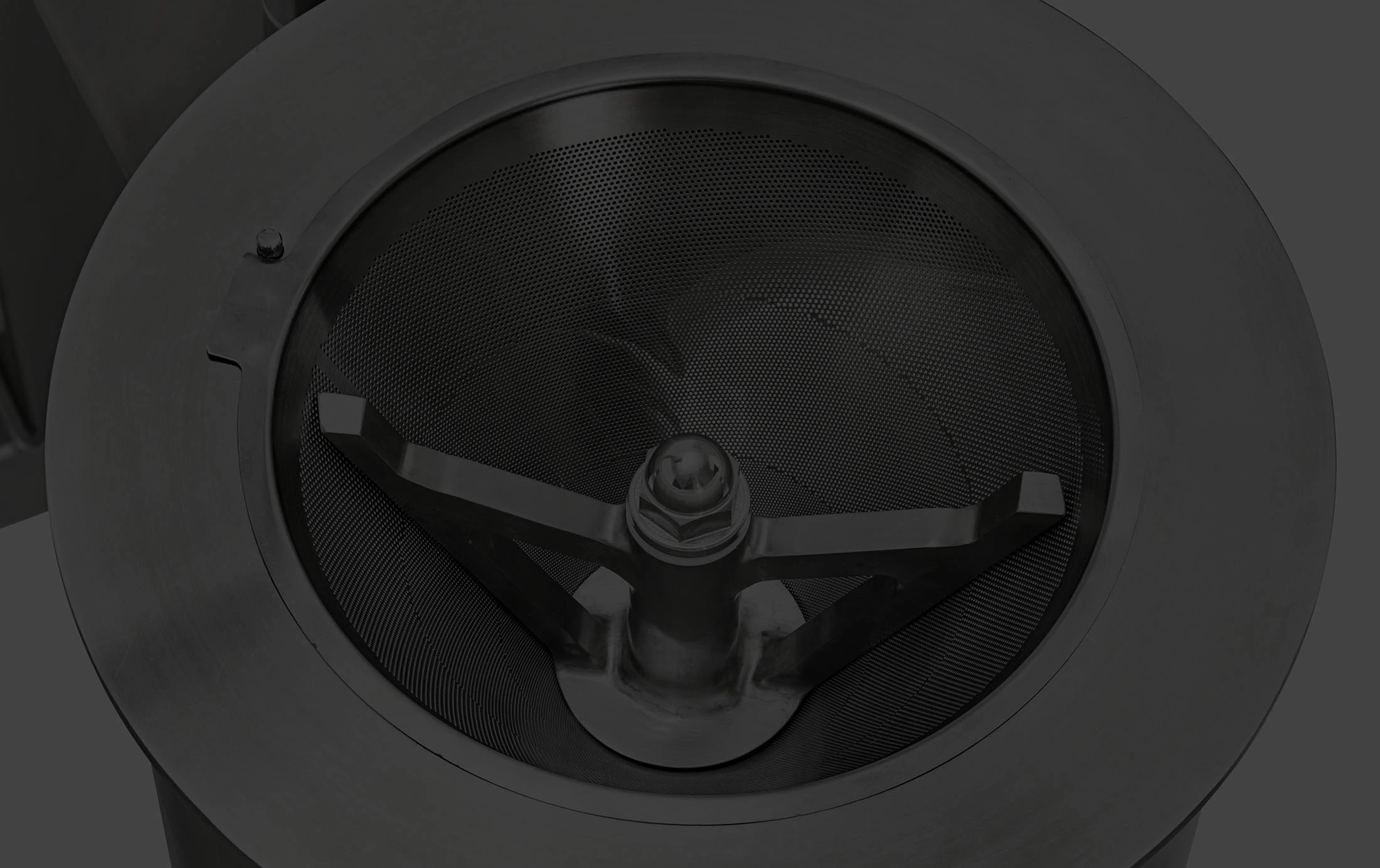
Cone mills, jet mills, and pin mills all appear on a shortlist for powder size reduction, but they do different jobs to varying degrees of success.
The differences between the three methods matter if a process needs to achieve a specific particle size distribution or if the material in question is sensitive to heat.
Mills that can produce the smallest particles may not always be the best choice. Fine grinding for no operational reason puts greater demands on the equipment and the powder, both of which can affect how it behaves later on in the process.
The comparisons in this blog will examine how each technology works, where their strengths and limitations lie, and the questions process teams need answers to before selecting a method.
Three Mills, Three Different Ways to Reduce Particle Size
1. Cone milling: controlled sizing through a screen
Cone milling is made up of a rotating impeller that moves material toward a screen’s openings. This process is considered to be a more gentle milling process and is not energy intensive, making it a useful process where controlled sizing, deagglomeration, and reduced heat generation are factors that need to be considered.
2. Pin milling: high-speed mechanical impact
A pin mill moves material through a high-speed grinding zone that's made up of sets of pins. Within this grinding size, materials are broken down far more aggressively than if it were in a conical screen mill.
Both the pin-disc’s configuration and how quickly it operates can affect how coarse or fine the grind is.
3. Jet milling: particle-to-particle collision
Jet milling is a process based around compressed air or another gas which forces particles to collide together. This collision provides the grinding action that a screen mill offers in conical milling.
This mechanism makes jet milling relevant when micronization - the creation of very fine particles - is central to the specification of the product.
Where Cone Milling Fits: Controlled Reduction Without Excessive Energy
What cone mills do particularly well
Cone milling is selected for controlled and repeatable particle reduction processes that don’t necessarily require reducing the material towards the smallest achievable particle size.
This low-energy operation is valuable for products that are affected by rises in temperature. Screen types and the impellers can also be controlled. Changing their geometry, for example, alters how long and how aggressively the material interacts with the screen.
Screens and impellers provide another useful control point. Changing their geometry alters how the material interacts with the screen and thus how it is processed.
Where a cone mill reaches its limit
On the spectrum of milling, conventional cone mills are on the mid particle size range end, so if a specification required particles deep into the micron range, then
another process may need to be selected because even an attempt to reduce the screen size won’t deliver the desired effect.
While a cone mill is good for gradual sizing and deagglomeration, those that require more intensive comminution may require a different high-energy conical system, pin mill, or other technology entirely.
Pin Mills Occupy the Middle Ground, But Their Capabilities Vary Widely
When mechanical impact is an advantage
Pin mills don’t rely on the same method as jet milling does, but can still produce fine powders from materials. Materials that are more likely to fracture under impact are often put through pin mills.
How fine they can make the powders depends heavily on the configuration of the machine. There is no set figure. Some counter-rotating pin mills can achieve results in the 10-500 µm range, while others can achieve finer results.
Pin milling is used when powders need to be reduced to a level that cone milling cannot achieve.
Heat, wear, and material behavior can change the calculation
The efficiency of high-speed mechanical contact also brings with it disadvantages. Excess heat or mechanical wear is not uncommon nor is it found in cone or jet milling.
Materials that are vulnerable to becoming sticky or elastic can clearly behave differently under impact, which means the feed properties need to be thought of on top of the particle size goals. Abrasive products put more pressure on the mechanisms because the multiple mechanical components that make up a pin mill are put to work for longer.
Abrasive products put greater scrutiny on the overall wear and the product-contact material selection because the grinding action involves multiple mechanical components.

Jet Milling Becomes Relevant When the Specification Moves Into Micronization
Why jet mills can achieve much finer particle sizes
The key characteristic of jet milling is that it fires particles at each other to encourage collisions and, as a result, particle size reduction. This unique process, very different to its conical and pin mill counterparts, makes it better suited to applications where a tight specification is in the lower micron range.
Jet milling is used in pharmaceutical applications and is an established method for producing particles below 10 µm, with specialist jet mills able to achieve 1-5 µm.
Because particles reduce their sizes by colliding, process teams don’t need to be so concerned about the contamination associated with materials that interact with grinding tools.
The performance comes with different process requirements
The introduction of compressed gas as part of the process makes jet milling a fundamentally different process than mechanically driven cone or pin mills.
Micronizing powders can also change the diameters of the particles, which, as their surface area increases, makes them finer and harder to handle downstream. As a result, a finer particle size should not be chosen simply because it is possible.
High-energy particle processing such as this can also affect materials found in pharmaceutical applications, so, for sensitive APIs, process development may need to include an examination of relevant material properties as well as the final PSD.
Choosing a Mill Starts With the Required Product Outcome, Not the Equipment Category
Selecting the right milling method begins by whittling down processes based on a target PSD. This target helps to create a shortlist. With that in place, the material and requirements will help engineers determine which options survive testing.
Start with the PSD the downstream process genuinely needs
Look for more than an average particle size. D10, D50, and D90 oversize and acceptable fines can all affect the assumption that two similar milling processes are actually equivalent.
A cone mill, for instance, may provide sufficient control for granular reduction and breaking up agglomerates. However, if finer mechanical grinding is needed, then the decision may sway to a pin mill, while micronization means a jet mill may be the most suitable process.
Defaulting to making the finest particles possible, more so than the downstream process requires, adds very little benefit and can often incur additional processing costs.
Then test the material against the mechanism
A number of material properties can affect how it responds to each of the mechanisms, such as:
- Hardness
- Friability
- Moisture
- Temperature sensitivity
Even those particle sizes which have similar targets can still require different equipment, which is all down to how they behave. A brittle powder, for example, is likely to fracture under impact whereas a material that is more sticky will smear across a screen, presenting an entirely different milling problem.
Compare the complete production requirement
Mills that produce the target result in small-scale laboratory settings may perform well, but they will still need to meet repeatable production capacities once they are scaled up.
Each mill has varying operating costs that differ substantially. Jet milling, for instance, can be more expensive because of the compressed gas it needs to operate. Mechanical mills, with their tooling, wear, and maintenance considerations, also have additional costs.
Regular testing helps to close the gap between how suitable a process is in theory and in the field. At Quadro, our Waterloo Technology Centre supports testing from sub-kilogram quantities to multiple batches of hundreds of kilograms. It can assess processes against all relevant properties including:
- Particle size
- Shape
- Bulk density
The Right Technology Is the One That Proves Itself With Your Material
The three types of milling laid out in this blog - cone, pin, and jet mills - all sit on the particle size reduction spectrum with enough overlap in their parts and features that particle size alone isn't enough to make a decision.
Shortlists can be defined by the PSD but then must be narrowed according to how the material behaves and the required production rate, among other things.
If cone milling has been deemed the most suitable, application trials give process teams crucial evidence and knowledge about how the process will work at scale. These processes can happen here at Quadro, where we’ve been developing Comil® conical milling technology since 1976.