Why the Right Food Mill Matters in Food Production
Choosing a food mill is often treated as a capital equipment decision, but its impact is felt every day on the production line. Milling performance influences particle size consistency, material flow rates, waste levels and ultimately product quality. Whether you are processing biscuits, snack products, dry mixes, or reclaiming off-spec material, selecting the right mill helps ensure reliable and repeatable production.
In practice, milling problems tend to appear as excessive fines, inconsistent particle size, poor flowability, or avoidable product waste. These problems often stem from a mismatch between the material being processed and the milling technology being used. Selecting equipment that matches the material characteristics and throughput requirements helps prevent these issues and ensure consistency and reduce rework.
A food mill that is not suited to your process will cause issues by generating excessive waste, and creating inconsistent particle sizes that cause quality failures further down the line in the form of excessive fines, or poor material flow. Selecting a mill that is matched to your manufacturing targets, and performs well will deliver tight particle size distribution on target, keeps your product quality intact, and adds flexibility to your operation that matches output as demand grows.
At Quadro Engineering, we have spent over 50 years working alongside food, pharmaceutical, and nutraceutical manufacturers to solve particle processing challenges across a wide range of applications.
What Food Manufacturers Actually Need from a Mill
A facility producing cookies that need to be reclaimed can have completely different milling requirements than one processing food blends or dry protein powders. Before you can choose the right mill, you need to be clear about what your process demands.
The key questions to ask are: What material am I processing? What particle size range do I need? Is my product heat-sensitive or prone to degradation? Do I need a system that can scale with my production volume? These questions are not just useful when buying a mill, they are the foundations of a smart manufacturing strategy. For example, factors such as material hardness, moisture level and fat content should be considered early in the selection process. If overlooked, they can lead to issues such as screen blockage, material smearing across the screens reducing the throughput or difficulty in achieving the PSD target.
These days manufacturers also need to think about waste recovery. In food production, off-spec product represents a real financial loss. A food mill that can reclaim that material and return it to the production stream represents a cost-saving asset with its own ROI.
Where The G96 Food Mill Fits in Food Manufacturing
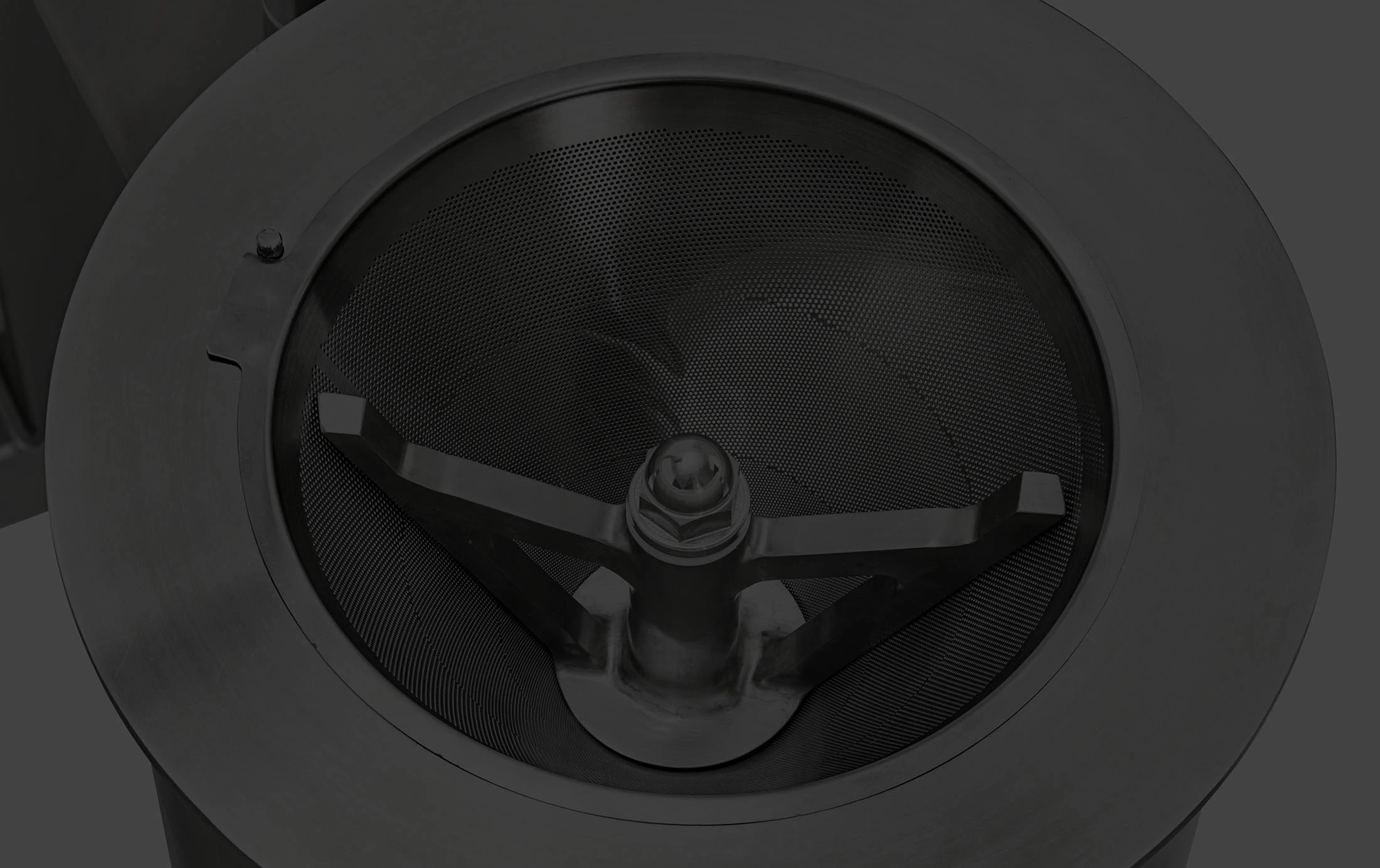
The Quadro G96 Food Mill is designed specifically with food manufacturing in mind. It handles a wide range of dry food applications, from size reduction of dry mixes and seasonings to the reclaim of cookies and biscuits. It delivers consistent, controlled results at production scale, helping to maintain product quality throughout processing.
One of the standout applications for the G96 Food Mill is cookie reclaim. When biscuits and cookies break or come out off-spec during production, that material is typically either discarded or sold at a loss. With successful reclaim, this ‘waste’ can be turned back into a uniform, usable powder that can be reintroduced into the process, reducing waste and recovering value that would otherwise be written off.
What makes the G96 Food Mill particularly well-suited to food manufacturing is its ability to gently handle delicate ingredients. It avoids excessive heat generation and aggressive mechanical action, which protects heat-sensitive ingredients and prevents product degradation. This is ideal for food processors working with flavour compounds, coatings, or fine-textured products.
Consistent Particle Size at Every Scale
One of Quadro Engineering's core strengths, built over five decades of milling innovation, is delivering narrow, precise particle size distribution. The G96F delivers that same Comil® standard into the food sector for reproducible results batch after batch, and consistency in every delivery.
In food processing, particle size affects how ingredients blend, how the material flows through the production equipment and how the final product performs. Oversized particles can lead to customer complaints and rework, while excessive fines can affect product performance and process efficiency. Not getting the particle sizes right ultimately affects the texture, mouthfeel and flavour release, of the ingredients which will impact the consumer experience and potentially result in customer complaints over quality.
How the G96 Food Mill Compares to Standard Milling Options
Many food production teams start out with general-purpose milling equipment not built specifically for food production demands. These machines can get the job done at low volumes, but they often fall short in three key areas: consistency, hygiene compliance, and product protection.
The G96 Food Mill is built to food industry standards, which means it is designed for cleanability and meets the hygiene expectations of modern food processing environments. It is also engineered to protect the product, reducing the risk of heat-related degradation that can compromise flavour or texture during processing.
Compared to general milling options, the G96F gives food processing operations a specifically designed tool that is easier to validate, easier to clean, and delivers better process control.
Getting Started: The PSD Card Offer
Understanding your particle size distribution is the first step to optimising your milling process. So a common question we hear from the food production teams is: "What screen size do I need to achieve my target particle size?" To help answer this, we've created a practical Particle Size Distribution (PSD) Reference Card.
The PSD card is a useful resource for production managers, process engineers, and quality teams who want to build tighter specifications into their milling operations.
To claim your PSD card and find out how the G96 Food Mill can work in your facility, get in touch with the Quadro Engineering team directly.
Frequently Asked Questions About Food Mills for Manufacturing
What is a food mill used for in manufacturing?
In food manufacturing, a food mill is used to reduce the particle size of dry materials, reclaim off-spec or broken product, and ensure consistent texture and flow characteristics across a batch. Applications range from processing dry ingredients and blends to reclaiming cookie and biscuit trim.
What makes the Quadro G96F different from other food mills?
The G96F was developed specifically for dry food processing applications. Compared with many general-purpose mills, it offers tighter control over particle size distribution, supports hygienic food production requirements, reduces the risk of heat damage or degradation and is commonly used for applications such as biscuit reclaim, dry ingredient milling, and seasoning processing.
Can the G96F handle heat-sensitive food ingredients?
Yes. The G96 Food Mill is designed to process materials gently, minimising heat generation during milling. This makes it suitable for flavour compounds, coatings, and other heat-sensitive food ingredients that can be compromised by aggressive milling action.
What is cookie reclaim and how does it work?
Cookie reclaim is the process of milling broken, off-spec, biscuit and cookie product back into a usable powder that can be reintroduced into the production process. The G96 Food Mill handles this application efficiently, producing a uniform output with minimal waste and without manual reworking steps.
What is particle size distribution and why does it matter?
Particle size distribution (PSD) refers to the range of particle sizes in a powder material. In food manufacturing, a tight PSD that can be repeated time after time means your product will be consistent texture, appearance, and flow behaviour. Wide or uncontrolled PSD leads to quality failures, inconsistent batches, and customer complaints.
How do I get a PSD card from Quadro Engineering?
You can request a complimentary PSD card by getting in touch with the Quadro Engineering team as part of the current G96 Food Mill campaign. The card is available to qualified food manufacturing enquiries.
Quadro Engineering is a global leader in particle processing, milling, and sifting solutions with over 50 years of experience serving the food, pharmaceutical, and nutraceutical sectors. The company is the originator of the Comil cone mill and is known for precise, controlled particle size reduction across a wide range of manufacturing applications