

The Quadro team works with a large customer base in over 80 countries, providing regular milling and particle sizing guidance. All our machines are designed and developed to the highest standards.
We appreciate that most materials vary in structure, and operators need guidance and advice to reach their desired target Particle Size Distribution and to produce reliable results. This is where our 50+ years of experience will prove invaluable in helping you to meet your preferred standards.
Whilst our team often comes across a varied range of milling questions, we regularly resolve some common issues experienced across various applications, from Pharma to Food. Whatever your need may be, our team is happy to help.
To assist you in solving some of the more common challenges, we have put together this short article covering some frequently asked questions.
- Industrial size reduction methods
- Particle size distribution
- Scaling up and future-proofing
- Milling specific powders
- Quadro technology
- Mill screen selection
Size Reduction Methods in Manufacturing
How does cone milling work?
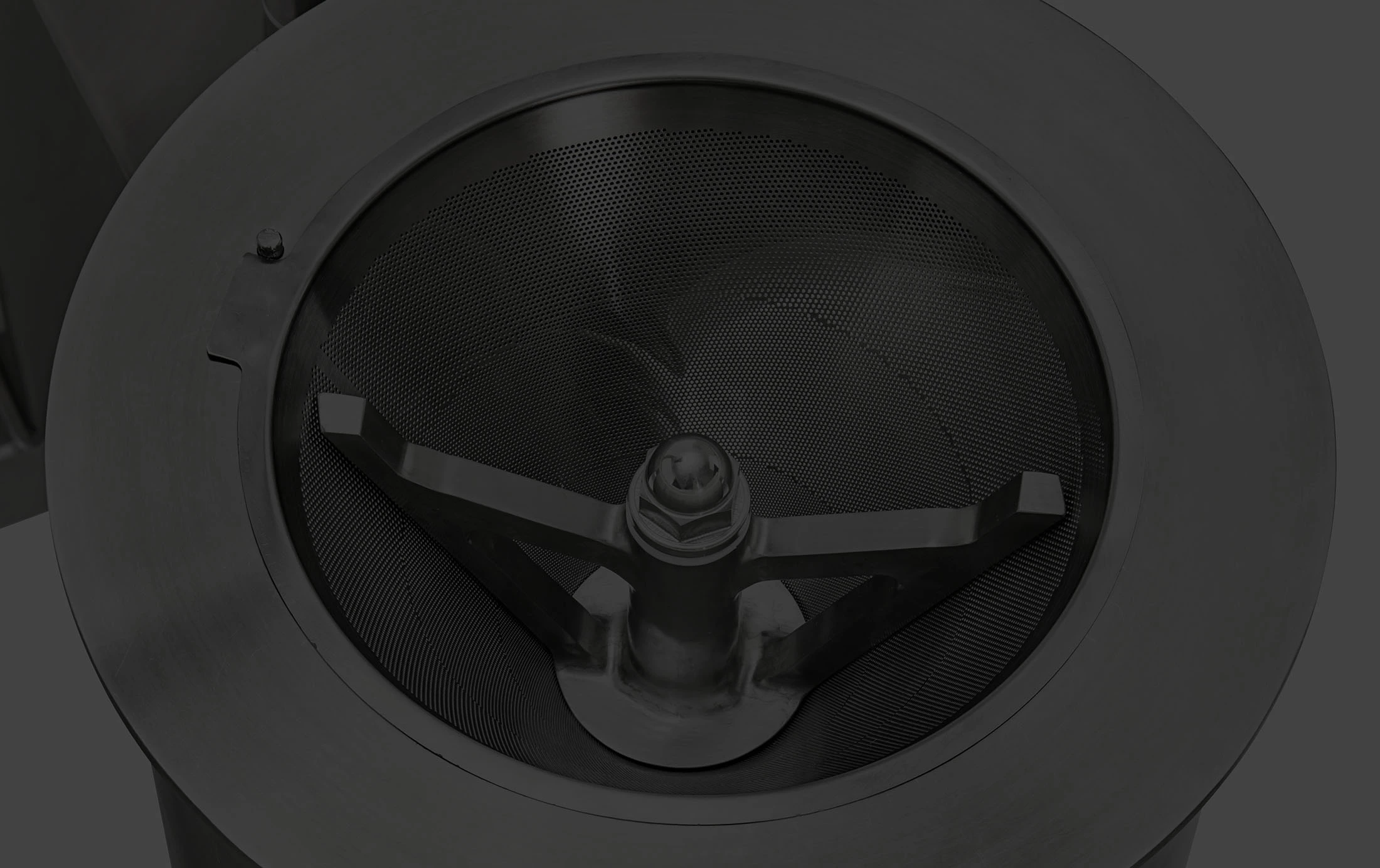
Cone milling is a gentle particle size reduction process that uses a rotating impeller and conical screen to break down agglomerates and produce a more uniform particle size. Material enters the milling chamber, where the impeller drives it toward the screen; as the particles interact with the impeller and screen, controlled shear and impact forces reduce them in size, and only particles small enough to pass through the screen apertures can exit the mill.
This controlled process helps manufacturers achieve consistent, repeatable results while protecting the integrity of sensitive materials. Key variables such as impeller speed, screen size, and feed rate determine the final particle size distribution, making cone milling a widely used solution in pharmaceutical, food, and nutraceutical processing where product quality, flow, and uniformity are critical.
Learn more: A brief overview of cone milling.
Do I need a conical mill or a hammer mill?
Conical mills and hammer mills both reduce particle size, but they do so in different ways and are suited to different processing priorities. Conical mills use lower shear and compression to deliver more controlled size reduction with less heat, dust, noise, and product degradation, making them well suited to applications where particle consistency and material integrity matter. Hammer mills use high-speed impact to break material down more aggressively, which makes them better suited to tougher, coarser, or more fibrous materials where rapid reduction and processing volume are the main priorities.
>Ultimately, the right choice depends on the material, the target particle size, and the wider process requirements. Conical mills are typically preferred for heat-sensitive powders, food and nutritional ingredients, deagglomeration, and applications with tight particle size specifications, while hammer mills tend to perform best when substantial size reduction in a single pass is needed.
Learn more: Conical mill vs hammer mill: which is right for you?
Particle Size Distribution
What is particle size distribution (PSD) and why does it matter?
Particle size distribution (PSD) describes the spread of particle sizes within a powder. It is commonly measured using D10, D50, and D90, which show the particle size below which 10%, 50%, and 90% of the sample falls.
PSD is important because it directly affects powder flow, blending, compaction, dissolution, and final product quality. In milling, the target PSD is shaped by factors such as the milling method, screen selection, impeller design, tip speed, feed rate, and material properties. Controlling these variables helps manufacturers achieve more consistent performance from development through to full-scale production.
Learn more: What is PSD and why is it important?
Does conical milling achieve consistent particle size distributions?
Yes, conical milling can achieve consistent particle size distributions because it combines controlled particle breakage with a calibrated screen that only allows material below a defined size to exit the mill. As material moves through the milling zone, the rotating impeller applies repeated impact and shear, while the screen sets a consistent upper size limit. This helps reduce batch-to-batch variation and makes it easier to keep PSD within specification.
With a fixed setup, conical milling can repeatedly reproduce the same PSD across batches and during scale-up, which is why it is widely used where consistent flow, compaction, dissolution, texture, or blend uniformity are critical.
Learn more: How cone milling delivers consistent results.
Scaling Up Your Milling Process
How do you scale from a lab mill to a production mill?
The process is simple, if the same parameters are transferred, then the particles or powders are exposed to the same milling forces. Therefore, the screens/impellers must have the same profiles and all that will then be remaining is a simple calculation regarding RPM.
Learn more: Choosing the right mill screen for your bulk powder solids.
Milling Application-Specific Powders
How to prevent overheating during the milling process?
There are several things to consider in order to protect heat-sensitive powders during milling, such as screen selection, RPM and mill type. Screen hole diameters and profiles are very important. For example, for dry milling, some commonly recommended hole profiles are round, grater (rasp) and Conidur. These profiles add resistance to the milling process and that resistance is increased or decreased depending on the hole diameter. Therefore, if you are experiencing problems with a particular screen hole diameter, one could use a hole size that is a little larger to reduce heat and then speed up the mill because the larger screen hole size will enlarge the particles. By increasing RPM, we are essentially making the apparent hole size smaller and then bringing the PSD back on target.
Learn more: Milling heat-sensitive materials.
How to hit target PSDs in wet granulation?
In the wet granulation process for manufacturing OSD pharmaceuticals, particle size distribution (PSD) must be controlled across three stages: pre-conditioning, wet milling, and dry calibration. Pre-conditioning removes agglomerates and creates a uniform feed, wet milling narrows wet granule size before drying, and dry calibration sets the final validated PSD before compression or filling.
Manufacturers achieve target PSDs more reliably when they manage wet granulation as an end‑to‑end process, rather than focusing solely on the final milling step. This is because PSD can shift at each step and directly affect tablet weight consistency, dissolution, disintegration, bioavailability, flow, and overall product quality. Consistent PSD then depends on controlling key variables such as screen configuration, impeller setup and speed, feed rate, moisture level, and tooling condition, with validation typically based on repeatable D10, D50, and D90 measurements.
Learn more: How to consistently hit your target PSD in wet granulation.
Quadro Automatic Head Recognition & RPM Adjustments
With the interchangeable head system, is there a chance that the operator could set the wrong RPM for one of the heads?
With our SMART-detect™ technology feature, the answer is “no”. Once a head is installed, SMART-detect™ ensures that the RPM can only operate within the range of a given piece of equipment. This is important as the FlexSift, Comil® and FitzMill™ all have different RPM ranges. For example, in order to scale up from a lab unit, the RPM must be within a specific range to ensure the results achieved are as were anticipated.
Learn more: discover the SDx™ Series with SMARTdetect™ technology
Choosing the Correct Mill Screen
How do I choose the right mill screen?
Infeed material comprised of 10mm - 20mm granules needs to be converted to between 2mm - 4mm only... 100% of the granules must be within range...what type of crusher or mill would be appropriate?
Depending on the nature of the product, we would recommend a mill with a larger infeed diameter so that the granules do not bridge. We would in all likelihood, recommend a square-hole or rectangular-hole screen with a large opening (6mm - 10mm) to pre-break the granules to the 2mm - 4mm range. The RPM may need to be slowed down a little so as not to create unwanted fines.
Learn more: read our article ‘choosing the correct mill screen for your bulk powder solids’
Do you have questions for our milling experts?
If you have a question for our team, please get in touch. You might be having an issue attaining your desired PSD, or your product may be degrading during the milling process.
We have probably experienced your problem previously and will, therefore, have a solution ready to go!